Building Practice Note - Direction to Fix, Building Notices and Building Orders
Abbreviations and definitions
Purpose
This Practice Note provides guidance to Relevant Building Surveyors (RBS) on the principal enforcement tools for addressing non-compliant building work. It outlines the roles of the Direction to Fix (DTF), Building Notices (BN), Building Orders (BO) and Emergency Orders (EO) and how they may be applied in context.
Overview
The Building Act 1993 (the Building Act) provides the RBS with a set of enforcement tools to bring building work into compliance. Table 1 below provides an overview of these and their application.
These tools support the overall powers and functions of the RBS in relation to building work, including:
- mandatory inspections and other inspections that the RBS requires
- the assessment of compliance at these stages
- issuing permit variations
- compliance assessment associated with applications for occupancy permits (OP) or considering a certificate of final inspection (CFI).
The RBS will engage with the building owner, design team, project manager and builder in these contexts, which give opportunities to state expectations for compliance and require materials to enable compliance assessment, which may not always rely on the use of a specific enforcement tool.
Table 1: Enforcement tool overview and application
| Enforcement tool | Issue to | Purpose | When issued | Escalation pathway |
|---|
| Direction to fix | Builder | Ensures accountability for the person/entity charged with the carrying out of building work and protects the owner from the costs of rectifying non-compliant building work. Intended to be a tool of first resort, when before OP or CFI. Can direct work to be stopped to enable inspection. | After inspection (mandatory stage or otherwise). | Referred to the BPC if not complied with. |
| Building Notice | Owner | Allows owner to respond before a BO is issued. Allows owner to consider any consequences from resolution of the matter such as immediate and ongoing costs | Concurrently with a DTF and/or Where a DTF is not appropriate. | May escalate to a BO. |
| Building Order | Owner *Builder | Requires action to be carried out which may sit outside the existing building permit (BP). | After a BN. | Referred to the BPC if not complied with, when issued by a PBS. |
| Building Order Minor Work | Owner *Builder | Requires action to be carried out which may sit outside the existing BP. | After inspection
(mandatory stage or otherwise). | Referred to the BPC if not complied with, when issued by a PBS. |
| Emergency Order (A private building surveyor (PBS) must refer to the municipal building surveyor (MBS) if considered to be a danger to life or property.) | Owner, Builder & if relevant Occupiers | Requires immediate action to be carried out to alleviate the danger. | Where MBS agrees there is a danger to | Failure to comply is an offence which carries penalties. |
*Builder – In limited circumstances under Section 111, the BO can be issued to the builder to allow them to undertake certain works (such as destructive testing) to demonstrate compliance.
Overall pathway to achieve compliance
Upon identifying a non-compliance during an inspection, the RBS must determine the most appropriate compliance action. This may involve issuing an Oral Direction to Fix (DTF), a Written Direction to Fix (DTF), or a Building Notice (BN). If an Oral DTF is considered the course of action, the RBS should turn their mind to how sufficient and defendable records are kept.
The RBS should issue a DTF in the first instance, wherever feasible, before considering the issue of a BN or BO. The Building Act directs that the building notice and order are a ‘last resort’ (s118A of the Building Act).
Whilst the DTF should be applied where feasible, it may not always be appropriate or possible to issue. The RBS will need to consider the context and apply a problem-solving approach, which may involve the issue of a BN or BO.
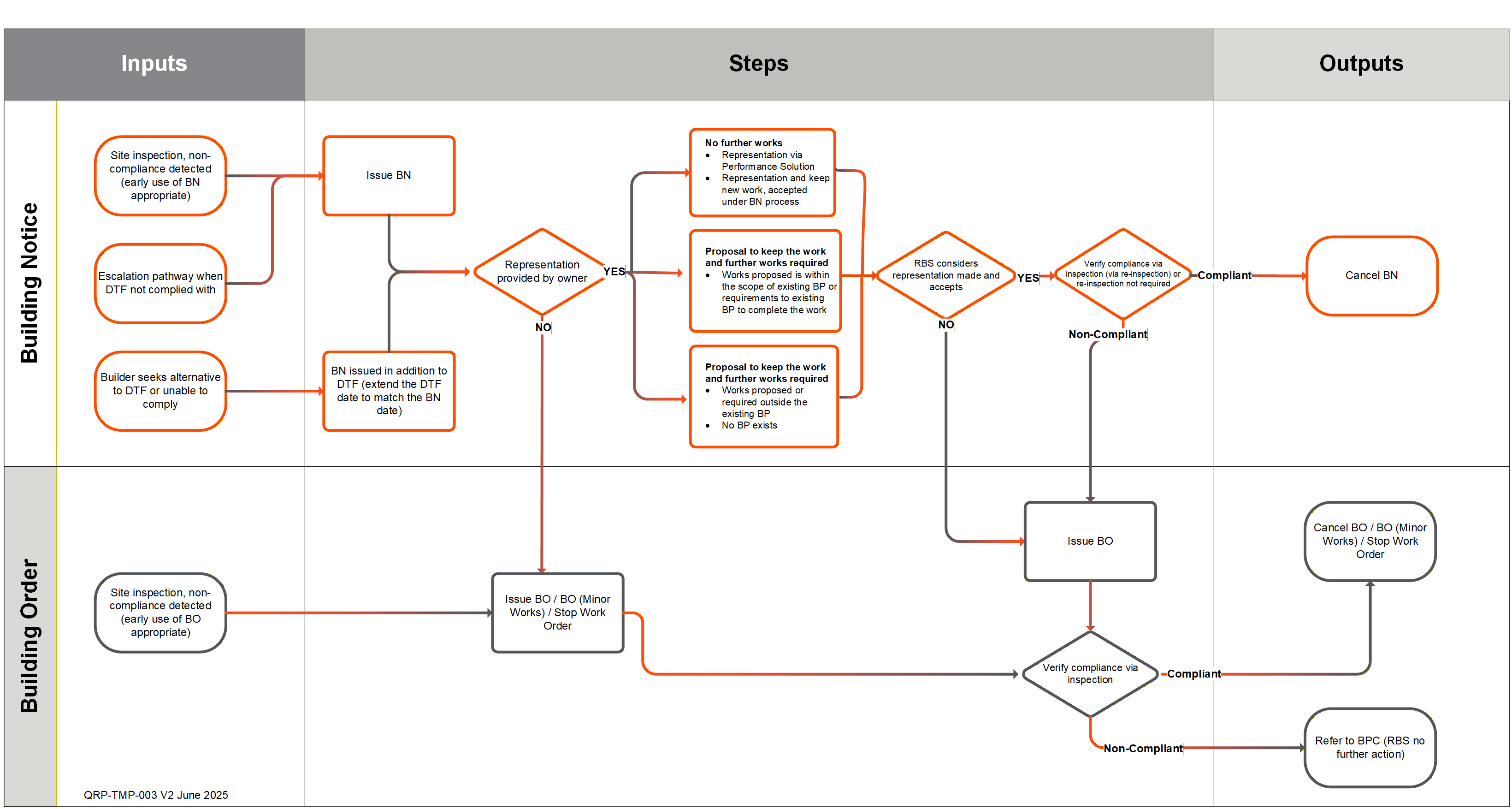
Figure 1 provides a structured guide for RBS for issuing either an oral or written DTF and BN, accounting for some of the limitations of the DTF. The following Sections guide on the key inputs, process steps, and expected outputs associated with the enforcement tools pathways.
Directions to fix
The following advice provides an overview of the DTF in the context of the BN/BO. Refer to Practice Note NO-02 Directions to fix building work for specific advice on grounds, timeframes, content, amendment, revocation and escalation of non-complied DTFs.
Oral direction to fix building work
Where suitable, the RBS may issue an Oral DTF, if the builder is able to rectify the non-compliant work within 7 days. Under Section 35A, the RBS must ensure that a record (such as a file note) of the Oral DTF is made in writing, including inspection information, as required by Regulation 173. A follow-up inspection should then be conducted to confirm that the work has been brought into compliance. If compliance is achieved, the RBS should issue a new Regulation 173 compliant inspection report.
Written direction to fix building work
A written DTF may be issued where:
- the non-compliance addressed by an Oral DTF persists upon a re-inspection, where the RBS must escalate to a written DTF
- the RBS chooses to issue a written DTF as a direct pathway to address the non-compliant work, e.g. when rectification is anticipated to exceed 7 days.
The RBS must consider whether the proposed rectification work aligns with the BP. A DTF can only direct work that complies or substantially complies with the BP. If it's not possible to issue a DTF to resolve the non-compliance, then moving directly to a BN/BO may be required.
The time nominated on the written DTF should be reasonable, based upon the extent of work required. Builders have rights to seek an amendment to a DTF, including an extension of time. Refer to Practice Note NO-02 Direction to Fix Building Work on how to manage amendments, using the DTF to stop associated building work, and re-inspection of work.
If the builder fails to comply with the DTF in part or wholly, the RBS must refer the matter to the BPC within 7 days of the compliance date, using the referrals portal and webforms.
Keeping the direction to fix in place whilst commencing a building notice
If the builder is unable to meet compliance with the requirements of the DTF (other than timing alone) or wishes to propose an alternative pathway for compliance, the RBS may:
- issue a BN to address the non-compliance
- extend the written DTF to match the BN date.
This extension to the DTF safeguards the owner, by ensuring the written DTF remains a valid compliance option whilst and until the BN process is resolved and avoids a situation where the RBS must refer a non-complied DTF to the BPC.
Once the non-compliance matter has been satisfactorily resolved through representations made and managed through the BN process, the RBS may proceed to revoke the written DTF and cancel the BN simultaneously. Otherwise, if the BN is escalated to a BO, the DTF may also be revoked upon issue of the BO.
Direction to fix underpinning a building notice for existing works outside of the permit
For works already done outside of the permit, the DTF may also lead to issuing a BN to facilitate amendments to the building permit, if appropriate.
Example
The builder wishes to propose other means to verify the works already done whether through a performance-based solution or by minor design changes not inconsistent with the permit, relating to structural works that do not change the outcome of the building.
By initially issuing a DTF with a direct compliance requirement (to bring back to the permit) and then exploring alternative approaches through the BN 'show cause' process, the RBS ensures that the owner is made aware of the proposed changes.
Building notice or building order where required
Early use of building notice or building order
In some situations, it might be appropriate to start with a BN/BO rather than a DTF. This includes:
- significant extent of non-compliance, including building work falling outside the scope of the current BP, and there is no feasible way of bringing about compliance through a DTF (which must align with the Act, the Regulations and permit)
- where there is no appointed builder responsible for the non-compliant work
- where the works would require involvement of reporting authorities (e.g. council, water authority, Fire Rescue Victoria), and a DTF could never facilitate a compliant outcome
- it is necessary to use a ‘show cause’ process to determine the state of the work, non-compliance etc
- it is necessary to issue a ‘Stop Work’ Order for specific work, or the site, independent of directing building work to be done (as a DTF can only stop work that may impede re-inspection of the non-compliant work) – the Stop Work Order could be followed by a DTF in these cases
- where the non-compliance is identified after the issue of the CFI or OP.
Note
The intent of this DTF is to protect the consumer against costs associated with rectification of non-compliant and defective building work, hence it must always be considered wherever it could play a role.
Escalating a building notice with non-compliance direction to fix referred to the BPC
When a DTF is referred to the BPC, the BPC will engage with the builder and consider appropriate enforcement action. This action may include partial suspensions, to focus the builder on completing the DTF before taking on other work. In some cases, an injunction may be considered.
BPC investigations, and subsequent enforcement actions, are focused on addressing the shortcomings of the builder, and supporting the RBS, but may not immediately resolve the state of non-compliance.
There remains a role for the RBS to address this non-compliance, whether assessing actions done by the builder following the BPC's intervention, or addressing the outstanding issues through a BN or BO.
Form 11 (BN) (PDF, 27.59 KB) includes ‘non-compliance with a DTF’ as grounds for issue for this reason.
The RBS should always consider the suitability of a BN for addressing the outstanding non-compliance, when making a DTF referral. The ‘show cause’ process can help resolve matters e.g. where the owner is the impediment to compliance, such as not providing access. It may also lead to the owner electing to engage another practitioner.
It may not always be necessary to issue a BN, such as where the non-compliance can be resolved later without affecting the next mandatory stage, or progression to occupancy or final inspection, and the owner has no influence on the compliance outcome.
The DTF remains in place once referred to the BPC. The DTF sets a compliance date but does not expire when compliance is not met.
Applying all available measures to secure compliance
The DTF requires the builder to do work to bring about compliance – principally this is building work, but may include associated reporting or validation, connected with that building work. Refer to the Practice Note NO-02 Direction to Fix Building Work for guidance on DTFs and requesting associated expert assessment or reporting
However, where the issue is unrelated the carrying out of building work, such as a standalone need to commission an expert assessment or report, the RBS may need to take other steps to secure a response. For example, one or more of the following may be appropriate:
- issue of a BO to stop work, for the specific issue or more broadly
- issue of a BN where a person has built outside of the permit, or to satisfy the RBS of compliance through the show cause process
- using the cover letter to outline how the practitioner can satisfy the RBS of compliance (such as an independent report) in order to lift a ‘stop work’ order or pass the inspection, refer to Practice Note NO-01 Building Notices and Building Orders for further guidance
- engaging with the owner or their agent on non-compliance concerns in appropriate circumstances, such as matters outside of the builder’s control or where there is a change in conditions
- recording the non-compliance in the inspection report.
Case studies – compliance pathways
Case Study 1: Oral direction to fix – non-compliant stairway (G.01)
Background
During a final inspection, RBS identified the non-fire isolated stairway (G.01) located in the ground floor lobby is non-compliant as:
- tactile indicators were not installed at the top and bottom of the stair landings
- contrasting non-slip nosing were not installed on the flight of stair.
Action taken
Given that the rectification was minor and expected to be completed quickly, the RBS issued an Oral DTF to bring the stairway into compliance with the existing building permit.
Follow-up inspection
The RBS returned to the site within 7 days and conducted a re-inspection. It was confirmed that the stairway was now compliant, with the required tactile indicators and non-slip contrasting nosing installed.
Outcome
Following confirmation of compliance, the RBS noted compliance with the Oral DTF in their inspection records, and no further enforcement action was required.
Case Study 2: Written direction to fix
Background
During an inspection, the RBS identifies in a Class 2 building >25m effective height, the following was not provided as per the BP documentation:
- exit signs to direct occupants to fire isolated stairs
- statutory signage to the fire stair doors
- portable fire extinguisher along the residential corridors
- sole occupancy unit balcony balustrades height is <1m throughout Level 20.
Action taken
Given the many outstanding items and the expected timeframe is >7 days to rectify, the RBS issued a Written DTF with a timeframe of 14 days to bring the building into compliance with the existing building permit.
Follow-up inspection
The RBS returned to the site within the 14 days period and conducted a re-inspection. It was confirmed all items within the Written DTF have been provided as per the BP documentation.
Outcome
Following confirmation of compliance, the RBS noted compliance with the Written DTF in their inspection records and the builder and owner were notified to confirm that the Written DTF is closed, no further enforcement action was required.
Case Study 3: Written direction to fix - escalation pathway to BN
Background
In an inspection of an office, the RBS identifies that infill currently being installed between the risers of public stairs is a perforated material rather than the approved solid/opaque material, which was specified for safety and visual impairment reasons.
Action taken
The RBS issues a Written DTF to bring the stairs into compliance with the permit. The builder, in consultation with the owner, provides information that the design variation had been put forward by the owner for aesthetic reasons and to allow natural lighting beyond the stairs.
Outcome
Following the representations, the RBS extends the date of the DTF by 28 days and issues a BN to the owner to show cause why the permit requirements should not be met.
As a representation to the BN, the owner engages a disability access consultant, who demonstrates that the substituted approach meets visual access requirements via a performance solution. The RBS is satisfied with the representation and therefore cancels the BN and revokes the DTF.
The variation is appropriately recorded and documented on the OP.
Diamond 1:
- a DTF is issued when the RBS reasonably believes the building work fails to comply with the Act, the Regulations, or the BP
- to be able to issue, the DTF needs to specify a compliance requirement that is consistent with the existing BP
- where a DTF can be issued, it may also lead to issuing a BN to facilitate amendments to the BP, where a compliance pathway option is proposed that is outside the current BP, for works already done. In these cases, the DTF acts as a protection for the owner from costs, until the BN/BO compliance pathway is resolved
- proceed directly to the BN process where appropriate (see ‘BN or BO where required’), e.g. where reporting authorities are involved, where a ‘stop work’ order is required, or a DTF could never facilitate a compliance outcome given the state of the build/non-compliance.
Diamond 2:
- an oral DTF may be given if the required rectification is expected to be completed within 7 days. The RBS may choose to go straight to a written DTF, including if the required rectification will take more than 7 days.
Diamond 3:
- where a written DTF can be issued and the builder is unable to comply, the RBS can modify the written DTF by revoking and reissuing of the written DTF or escalate to the BN process by extending the DTF date to match the BN date.
Diamond 4:
- where a written DTF can be issued, a builder can seek an extension of time for the written DTF as appropriate and this is managed through the process
- a builder may seek an alternative option to the DTF via the BN process to achieve compliance. The RBS can consider to accept or decline the proposed alternative.
Direction to fix timeframes and extensions (including where a BN/BO is considered)
- the timeframe for complying with the written DTF should be appropriate for the extent of work required to bring the non-compliance back into compliance
- extending the timeframe for the written DTF to run parallel with a BN, leaves the option open for compliance actions to ‘revert’ to the existing BP. This provides protection to owner should they not wish to pursue the alternative (due to costs or for other reasons)
- the request for extension should be based on legitimate reasons. Refer to Practice Note NO-02 Directions to fix building work for guidance.
Revoking the direction to fix when other instruments are in place
- where a DTF was initially issued to bring in-situ building works into compliance with the permit, but that building is subsequently ‘accepted’ under the BN/BO process, then the RBS may revoke the DTF
- if BO or BO Minor Works is issued, the RBS may revoke the DTF, as a BO covers the same matter, and now the builder can ‘no longer comply’ with the DTF as the other instruments are in place and directing the actions required
- where works already completed are accepted under the BN process – and no further work is required, then can revoke the DTF.
Recording of works as built including performance solutions
Any practitioner not listed on the BP (for example a designer or engineer) must be listed on the Application for Occupancy Permit (Form 15) by the applicant, and the acceptance of any performance solutions must be reflected on the OP-Form 16.
It is also good practice to endorse any documents or variations accepted under the BN process for future clarity and to ensure appropriate records are developed/kept. These documents must also be sent to council with the OP documentation. This will be of particular importance for documentation to form part of the Building Manual where prescribed by the Regulations.
RBS record-keeping obligations
Documenting and maintaining records related to these instruments is of paramount importance for RBS. This is essential for demonstrating compliance with legal and evidentiary obligations, especially in cases of referrals or disciplinary actions, and is explicitly required by the 'Code of Conduct for Building Surveyors' in Victoria:
- building surveyors must record all relevant information gathered during their services
- decisions must be supported with documented reasons
- all advice, opinions, decisions, and actions must be backed by evidence and factual findings
- documentation must be sufficient to meet the BPC's audit or investigation requests
- records may need to be provided to third parties in future regulatory or legal processes.
Practice note disclaimer
Version history
This version published
24 December 2025