

Was this page helpful?
Your rating will help us improve our website.





The Victorian Appendix to the NCC 2025 has been amended to reduce the number of variations and additional clauses from 115 to 60 across the three volumes of the NCC.
These changes will come into effect 1 May 2026.
We’ve updated the Victorian Appendix to reflect new and amended clauses, as well as clauses that have been removed.
You’ll find tables below that clearly set out these changes across four sections:
Each table highlights what’s new, what’s changed, and what’s been deleted, so you can quickly see how the updates may affect you.
Note: The final wording will be published in NCC 2025. The wording may be subject to change from the tables; however, the intent of the clause will remain the same.
| NCC 2025 reference | NCC 2022 reference (if applicable) | NCC 2025 clause* | New / amended |
|---|---|---|---|
| VIC A2G2 | A2G2 | VIC A2G2 performance solutions | New |
(1) A Performance Solution is achieved by demonstrating:
(2) A Performance Solution must be shown to comply with the relevant Performance Requirements through one or a combination of the following Assessment Methods:
(3) Where a Performance Requirement is satisfied entirely by a Performance Solution, the following method must be used:
(4) Where a Performance Requirement is satisfied by a Performance Solution, the following must be undertaken:
(5) A Performance Solution cannot be used to satisfy certain combustible cladding requirements. LimitationsWhere compliance with B1P1(2) or H1P1(2) is proposed to be satisfied by a Performance Solution, it must:
NotesThe limitation above does not take effect until 1 year after adoption of NCC 2025. | |||
| VIC A5G4 | A5G4 | VIC A5G4 Evidence of suitability – Volume 3 (PCA)(1) Any product that is intended for use in contact with drinking water must comply with the relevant requirements of AS/NZS 4020, verified in the form of either:
(2) Any product that contains copper alloy and is intended for use in contact with drinking water must have a weighted average lead content of not more than 0.25% verified in the form of either:
(3) A product of a type listed on the WaterMark Schedule of Products is deemed to be fit for its intended purpose if it has a WaterMark Licence issued in accordance with the WaterMark Scheme Rules. (4) A product of a type listed on the Watermark Schedule of Excluded Products requires evidence of suitability in the form of:
(5) Any product that is not covered by (3) or (4) must be subjected to a risk assessment in accordance with the WaterMark Scheme Rules. (6) Evidence to support that a design or system meets the relevant PCA Performance Requirements must be in the form of any one or any combination of the following:
NotesOn-site wastewater management systems larger than covered by the standards are exempt and a Performance Solution is required. | |
ApplicationsProducts subject to the requirements of A5G4(2) are specifically nominated in the WaterMark Schedule of Products and the WaterMark Schedule of Excluded Products. Exemptions(1) Products that are used exclusively for non-drinking uses such as manufacturing, industrial processing, irrigation or any other uses where water is not anticipated to be used for human consumption are excluded from the requirements of A5G4(2). Explanatory informationSome examples of products subject to A5G4(2) include the following:
Some examples of products excluded from the requirements of A5G4(2) include the following:
A5G4(1) requires any product intended for use in contact with drinking water to comply with AS/NZS 4020. Compliance is achieved by passing the relevant tests set out in the Standard. Evidence of compliance must then be provided in accordance with A5G4(1), under which there are two options. The first, at A5G4(1)(a), recognises test reports and certificates that cover compliance with AS/NZS 4020 only. The second, at A5G4(1)(b), recognises WaterMark Licences where compliance with AS/NZS 4020 is a requirement of the relevant product Standard or WaterMark Technical Specification. For products that are of a type listed on the WaterMark Schedule of Products, A5G4(2) requires that these products have a WaterMark Licence. A WaterMark Licence reflects that the product has been certified and authorised in accordance with the WaterMark Scheme Rules. For products that are not subject to WaterMark certification (i.e. excluded products), evidence that can be used to support that the product is fit for its intended purpose is provided in A5G4(3). This may include demonstrating compliance with a product specification referenced in the WaterMark Schedule of Excluded Products, where one is available. A5G4(4) provides that any product that is not listed on the WaterMark Schedule of Products or the WaterMark Schedule of Excluded Products must be subjected to a risk assessment in accordance with the WaterMark Scheme Rules. The risk assessment will determine whether the product in question requires certification and authorisation, or if it should be listed as an “excluded product”. This in turn will determine the form of evidence of suitability applicable to the product. Explanatory information: What is WaterMark?The WaterMark Certification Scheme is a mandatory certification scheme for plumbing and drainage products to ensure that these products are fit for purpose and appropriately authorised for use in a plumbing or drainage system. The PCA, through Part A5, requires certain plumbing and drainage products to be certified and authorised for use in a plumbing or drainage system. These products are certified through the WaterMark Certification Scheme and listed on the WaterMark Product Database. The WaterMark Certification Scheme is governed by the WaterMark Scheme Rules, which are available for download from the ABCB website at: www.abcb.gov.au. These rules set out the requirements for risk assessments, evaluation, certification, and the drafting of WaterMark Technical Specifications. When a product is listed on the WaterMark Schedule of Products then, for it to be certified and authorised, the product must—
Products that comply fully with the applicable requirements of the WaterMark Certification Scheme are then eligible to be certified by a WaterMark Conformity Assessment Body and listed on the WaterMark Product Database. Certified products are identifiable by the WaterMark certification trade mark, shown in Figure A5G4 below, that must be displayed on the product upon granting of a WaterMark Licence. Figure A5G4 (explanatory): WaterMark Certification Scheme Trademarks
| |||
| Definitions | N/A | Children’s room: a room used exclusively for the care or education of children while the children are attending the service, but does not include a toilet, a kitchen, an administration room or any other ancillary area. | New |
| Definitions | Definitions | Restricted children’s service: A children’s service that is a limited hours service as defined in the Children’s Services Regulations 2020 | Amended |
| NCC reference | NCC 2022 clause for deletion |
|---|---|
| Definitions | Children’s service Has the same meaning as it has under the Children’s Services Act 1996, but excludes a service where education and care is primarily provided to school aged children. |
| Definitions | Early childhood centre Includes:
|
| Definitions | Flashing Includes:
|
| Definitions | On-site wastewater management system A system that receives and/or treats wastewater and discharges to disposal, reuse, or land application systems.
|
| NCC 2025 reference | NCC 2022 reference (if applicable) | NCC 2025 clause* | New / amended |
|---|---|---|---|
| VIC B1D6 (3) | VIC B1D6 (3) | VIC B1D6 (3) Construction in Buildings in Flood Hazard Areas(3) The definition of defined flood level in the ABCB Standard for Construction of Buildings in Flood Hazard Areas is replaced with that in Schedule 1. | Amended |
| VIC D2D1(1) | N/A | VIC D2D1(1)(a) Deemed-to-Satisfy ProvisionsD2D2 to VIC D2D24, D3D2 to D3D31 and D4D2 to D4D13; and | New |
| VIC D2D9 | VIC D2D9 & VIC I4D3 | VIC D2D9 Width of doorways in exits or paths of travel to exits(1) Drafting as per national D2D9 Notwithstanding (1), in Class 3 and Class 9a residential aged care buildings, the unobstructed width of all bedroom entrance doorways must be not less than 900 mm. | Amended |
| VIC D2D24 | VIC I6D3 | VIC D2D24 Doorways to a children’s roomIn an early childhood centre, a children’s room must:
| Amended |
| VIC D3D26 | VIC D3D26 (6) | VIC D3D26(1) Operation of latch
| Amended |
| VIC E1D6 | VIC E1D7 | VIC E1D6 Where sprinklers are required: Class 2 and 3 buildings other than residential care buildings
| Amended |
| VIC S17C15 | VIC S17C2 | VIC S17C15 Balconies in Class 2, 3, 9a and 9c buildingsCovered balconies in Class 2, 3, 9a or 9c buildings must be sprinkler protected. | Amended |
| VIC S18C5 | VIC S18C3 | VIC S18C5 Balconies in Class 2 and 3 buildingsCovered balconies in Class 2 or 3 buildings must be sprinkler protected. | Amended |
| VIC F4D2 | VIC I4D5 | VIC F4D2(6) Grabrails(6) In addition to (3) and (5), in a Class 3 and 9a residential aged care building and Class 9c building, grabrails must be provided in association with every closet pan, shower or bath utilised by residents in accordance with AS 1428.1. | Amended |
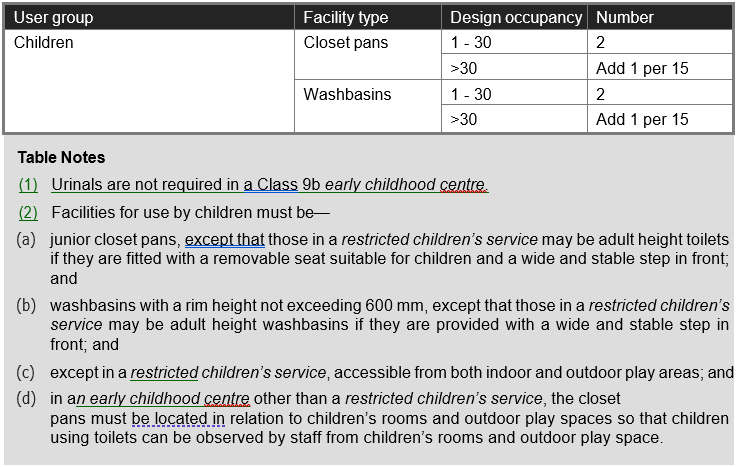
| VIC F4D4 | VIC F4D4 | F4D4 – Facilities in Class 3 to 9 buildings
VIC Table F4D4g: Sanitary facilities in Class 9b buildings – early childhood centres
| Amended |
| VIC F4D13 (1) | VIC F4D13 (1) | VIC F4D13 First aid roomsIf an assembly building, or an open spectator stand accommodates more than 5000 spectators at an arena, sportsground, showground, racecourse, cricket ground, football ground, coursing ground, motor racing arena, or the like, a suitable room or rooms must be provided in accordance with VIC Table F4D13 for use by para-medical attendants for first aid purposes. | Amended |
| VIC I4D1 | VIC I4D1 | VIC I4D1 Deemed-to-Satisfy ProvisionsPerformance Requirement VIC I4P1 is satisfied by complying with VIC I4D2. | Amended |
| VIC I4D2 | VIC I4D6 | VIC I4D2 Electronic communication systemA communication system must:
Applications VIC I4D2 only applies to Class 3 and Class 9a residential aged care buildings and Class 9c. | Amended |
``
NCC Reference | NCC 2022 clause for deletion |
VIC D2D5 | VIC D2D5 Exit travel distances |
VIC E1D7 | VIC E1D7 Where sprinklers are required: Class 3 building |
VIC E1D13 | VIC E1D13 Where sprinklers are required: occupancies of excessive hazard |
VIC S17C2 | VIC S17C2 Application of automatic fire sprinkler standards |
VIC S18C3 | VIC S18C3 System requirements |
VIC S20C4 | VIC S20C4 Smoke detection system |
VIC S20C8 | VIC S20C8 System monitoring |
VIC F4P2 | VIC F4P2 Laundry facilities |
VIC G1P2 | VIC G1P2 Swimming pool access and water recirculation system |
VIC G1D2 | VIC G1D2 Swimming pools |
VIC Part G5 | VIC Part G5 Construction in bushfire prone areas
|
VIC I4P2 | VIC I4P2 Electrical power outlet |
VIC I4D3 | VIC I4D3 Doorway width |
VIC I4D4 | VIC I4D4 Windows |
VIC I4D5 | VIC I4D5 Grab rails |
VIC I4D7 | VIC I4D7 Electrical power outlets |
VIC Part I5 | VIC Part I5 Places of public entertainment
|
VIC Part I6 | VIC Part I6 Class 9b children’s services
|
NCC 2025 Reference | NCC 2022 Reference (if applicable) | NCC 2025 clause* | New / amended |
VIC H2D6 | VIC H2D6 | H2D6 Roof and wall cladding(1) Performance Requirement H2P1 is satisfied for gutters and downpipes if they are designed and constructed in accordance with AS/NZS 3500.3. (3) This subclause is deleted and does not apply in VIC. | Amended |
NCC Reference | NCC 2022 clause for deletion |
VIC H6V1 | VIC H6V1 Application of H6V2 and H6V3 The Verification Methods in this Part only apply to—
Notes The Victorian NCC 2019 rainwater tank variation (VIC V2.6.1 and V3.12.0 respectively) remains in effect until 30 September 2023 after which the following takes effect: A rainwater tank must be installed in a Class 1 building in accordance with the regulations made under the Building Act 1993 (Victoria). This Victorian rainwater tank requirement is now found in NCC 2022 Volume Three (Clauses VIC B6D2 and VIC B7D4). |
VIC H6D2 | VIC H6D2 Application of Part H6
Notes: Victorian rainwater tank variation The Victorian NCC 2019 rainwater tank variation (VIC V2.6.1 and V3.12.0 respectively) remains in effect until 30 September 2023 after which the following takes effect: A rainwater tank must be installed in a Class 1 building in accordance with the regulations made under the Building Act 1993 (Victoria). This Victorian rainwater tank requirement is now found in NCC 2022 Volume Three (Clauses VIC B6D2 and VIC B7D4). Explanatory information There are two Deemed-to-Satisfy pathways for complying with the energy efficiency Performance Requirements:
|
| NCC 2025 Reference | NCC 2022 Reference (if applicable) | NCC 2025 clause* | New / amended |
|---|---|---|---|
| VIC B1D3 | VIC B1D3 | VIC B1D3 General Requirements(1) A cold water service must be in accordance with AS/NZS 3500.1. (2) Notwithstanding (1), all pipes and fittings used above-ground that supply fire hydrant systems, including combined sprinkler and hydrant systems, must comply with the material requirements of AS 2419.1 for above-ground pipework as for hydrant system pipes and fittings. (3) A hose tap must be provided adjacent to urinals in sanitary facilities that are open to the public. | Amended |
| VIC B3D3 | VIC B3D3 | VIC B3D3 General requirementsA non-drinking water service must be in accordance with AS/NZS 3500.1, subject to the following: Substitute clause 9.7.1(a) as follows: 9.7.1(a) be of a type that has a removable handle; Substitute the text of clause 9.7.1(c) as follows: 9.7.1(c) have a non-standard inlet connecting thread and a standard hose connection outlet. | Amended |
| VIC B4D2 | VIC B4D2 | VIC B4D2 General Requirements(1) Fire-fighting water services for Class 2 to Class 9 buildings and structures must comply with the requirements of Part E1 of Volume 1 of the NCC. (2) The installation of a fire-fighting water service must be in accordance with AS/NZS 3500.1. (3) Fire-fighting water service work must be in accordance, as appropriate, with:
Explanatory information NCC Volume 1 requires the installation of fire-fighting equipment including fire hose reels, fire hydrants and automatic fire suppression systems in certain types of buildings. The installation of fire-fighting water services in Class 1 buildings is not required by NCC Volume 2, however, where these services are installed voluntarily, they must be in accordance with Part B4. | Amended |
| VIC B6P8 | VIC B6P7 | VIC B6P8 Rainwater service(1) A rainwater service must-
Application B6P8(1)(d) applies if a reticulated water supply from a network utility operator is connected, or proposed to be connected, to a building where a rainwater tank is installed for the purpose of sanitary flushing. | Amended |
| VIC B6D1(1) | VIC B6D1(1) | VIC B6D1(1) – Deemed-to-Satisfy Provisions(1) Where a Deemed-to-Satisfy Solution is proposed, Performance Requirements B6P1 to B6P8 are satisfied by complying with B6D2 to B6D8. | Amended |
| VIC B6D8 | N/A | VIC B6D8 Automatic or manual interchange device
Application B6D8 applies if a reticulated water supply from a network utility operator is connected, or proposed to be connected, to a building where a rainwater tank is installed for the purpose of sanitary flushing. | New |
| B5D7(6) | S41C4(3) | Insert under B5D7 (6) as follows: (x)A water point installed adjacent to a water closet that is not connected to a sanitary fixture (e.g. handheld douche spray). B5D7(6) Exemptions
| New |
| VIC C2D4 | VIC C2D4 | (1) A sanitary drainage system must be in accordance with AS/NZS 3500.2; subject to the following—
15.1(A) Testing of a sanitary drainage installation.
(2) Insert Clause 3.10.3.1 after Clause 3.10.3 as follows: Clause 3.10.3.1 Discharge pipes measuring DN 50 or smaller must not be installed in a below ground sanitary drainage system, except for discharge pipes connected to floor waste gullies or vertical riser from a graded drain. | Amended |
| VIC C4P1 | VIC C4P1 | VIC C4P1 Requirements for low risk on-site liquid trade waste management practicesA low risk liquid trade waste appliance must—
(2) A low risk liquid trade waste appliance must—
(3) If a low risk liquid trade waste appliance and outlet vent are interconnected, the interconnection must be in accordance with the Network Utility Operator’s specifications, requirements, or standard drawings. (4) The outlet from a low risk liquid trade waste appliance must— (5) In this clause hydraulic loading means the rate of discharge imposed on a sanitary plumbing installation and is measured in fixture units; low risk liquid trade waste means water-borne discharges other than sewage that are classified by an Authority within the meaning of the Water Act 1989 as being of low risk from causing harm to the environment and the assets of that Authority; low risk liquid trade waste appliance means an appliance that traps and partially or wholly treats low risk liquid trade waste and prevents it from entering the sewerage system. Notes The relevant Authority under the Water Act 1989 or the holder of a licence under the Water Industry Act 1994 may specify conditions of connection to a sewer for low risk trade waste to enter that sewer and may also require that the waste passes through a low risk liquid trade waste appliance of a type nominated by the Authority or holder of a licence before it enters the sewer. | Amended |
| VIC E3P1 | VIC E3P1 | E3P1 Roof drainage systemsA roof drainage system must dispose of stormwater flows from rainfall events having an annual exceedance probability appropriate to: (a) The importance of the building. (b) The severity of potential damage to property, loss of amenity, illness or injury that would result from the failure of the system. | Amended |
| VIC E3P2 | VIC E3P2 | VIC E3P2 OverflowA roof drainage system must have an appropriate overflow device to transfer stormwater flows so that it avoids damage to property or hazard to people from a storm with an annual exceedance probability of 1%. | Amended |
| VIC E4 | VIC E4 | Part E4 Stormwater – Surface drainage Systems | Amended title |
| VIC E4O1 | VIC E4O1 | VIC E4O1 ObjectiveThe Objective of this Part is to—
| Amended |
| VIC E4F1 | VIC E4F1 | VIC E4F1 Functional statementBuildings and their surroundings are to be provided with a surface drainage installation and be constructed in such a manner as to provide protection for people, property and the environment from the adverse effects of stormwater. | Amended |
| VIC E4D2 | VIC E4D2 | VIC E4D2 General requirementsThe design, construction, installation, replacement, repair, alteration and maintenance of surface drainage systems must be in accordance with AS/NZS 3500.3. | Amended |
| NCC Reference | NCC 2022 clause for deletion |
|---|---|
| VIC B2P3(1) | VIC B2P3(1) - Velocity |
| VIC B2P4(1) | VIC B2P4(1) - Access and isolation |
| VIC B2P7(3) | VIC B2P7(3) - Energy use and source |
| VIC B2D2(5) | VIC B2D2(5) - Water heater in a heated water supply system |
| VIC B2D5 | VIC B2D5 - Maximum delivery temperature |
| VIC B2D6 | VIC B2D6 - Temperature control devices |
| VIC B3P3(1) | VIC B3P3(1) - Velocity |
| VIC B4P2(2) | VIC B4P2(2) - Access and isolation |
| VIC B6D2 | VIC B6D2 - General requirements |
| VIC B7P1 | VIC B7P1 - Contamination control |
| VIC B7P5 | VIC B7P5 – Identification (previously numbered as B7P4 in PCA 2022) |
| VIC B7D1 | VIC B7D1 - Deemed-to-Satisfy Provisions |
| VIC B7D4 | VIC B7D4 – Identification (previously numbered as B7D3 in PCA 2022) |
| VIC B7D5 | VIC B7D5 - General requirements (previously numbered as B7D4 under PCA 2022) |
| VIC B5D7(3) | VIC S41C3(3) - Protection types and hazard ratings (renumbered as B5D7 in PCA 2025) |
| VIC B5D7(6) | VIC S41C4(3)(w) |
| VIC B5D7 | VIC S41C6 Containment protection |
| VIC C1D3 | VIC C1D3 General requirements |
| VIC C2P8 | VIC C2P8 No point of connection |
| VIC C2V2 | VIC C2V2 Pressure testing |
| VIC C3P1 | VIC C3P1 Health impacts |
| VIC C3P5 | VIC C3P5 General requirements |
| VIC C3P6 | VIC C3P6 Land application systems |
| VIC C3P7 | VIC C3P7 Access for maintenance |
| VIC D1F1 | VIC D1F1 Excessive noise |
| VIC D1D2 | VIC D1D2 Undue noise |