
Was this page helpful?
Your rating will help us improve our website.





The BPC (formally the Victorian Building Authority) commissioned an independent full-scale fire test through a National Association of Testing Authorities accredited laboratory on a rendered external wall system in June 2020 to test the fire spread performance of EPS (with fire retardant) in Exterior Insulation Finishing Systems (EIFS) on Class 2-9 buildings of Type A or Type B construction.
The rendered EPS (with fire retardant) in EIFS was deemed to have failed to meet the AS5113 EW classification acceptance criteria and failed to meet the BR135 classification. The test results provide a clear indication that the use of rendered EPS (with fire retardant) in EIFS on Class 2-9 buildings of Type A or Type B construction would result in a rapid vertical fire spread and pool fires when exposed to a large fire source, such as from a window opening or external source.
Rendered Expanded Polystyrene (EPS) is a form of cladding that gained popularity in the building industry over the last 20 years for use on external walls. This was mainly due to its lower cost, insulation properties and lightweight nature. However, polystyrene is a thermoplastic product that has a very poor reaction to fire.
The BPC has heard differing views from the building industry on the use of EPS in EIFS on Class 2-9 buildings of Type A or Type B construction. These discussions have often been in the context of risk ratings and cladding rectification proposals as part of the Statewide Cladding Audit program. Some have argued EPS will perform satisfactorily in fire due to the protective concrete render or because it will melt rather than burn and propagate fire. Others have argued the product presents an intolerable risk of spread of fire when used on Class 2-9 buildings of Type A or Type B construction.
Currently in Australia, there is limited clear, independent and authoritative evidence regarding the fire spread performance of EPS in EIFS on Class 2-9 buildings of Type A or Type B construction.
This lack of information has contributed to an increased risk to public safety as some building designers, builders and building surveyors may not be aware of the fire safety risks associated with EPS in EIFS. This is compounded by some continued use of non-compliant products in the construction of external wall systems of Class 2-9 buildings of Type A or Type B construction which could include a combination of EPS in EIFS with other combustible cladding products or wall elements.
The fire tests were conducted by Warringtonfire Australia1 (Warringtonfire) in June 2020 and witnessed by the Commonwealth Scientific and Industrial Research Organisation (CSIRO)2.
The fire spread test was conducted in accordance with AS 5113:2016 Classification of external walls of buildings based on reaction-to-fire performance. This standard sets out the procedures for the fire propagation testing and classification of external walls of buildings according to their tendency to limit the spread of fire via the external wall and between adjacent buildings.
The BS 8414‑2:2015 + A1:2017 full-scale façade test method, as specified within AS 5113, was applied. The test system was built to be representative of typical rendered EPS (with fire retardant) in EIFS on Class 2–9 buildings of Type A or Type B construction in Victoria and was conducted in accordance with the AS 5113 External Wall (EW) classification test.
The rendered EPS (with fire retardant) in EIFS was deemed to have failed to meet the AS 5113 EW classification acceptance criteria and also failed to meet the BR135 classification. It was notable that, at the seven-minute mark of the test, molten flaming EPS was emanating from the test rig and flames were five metres above the combustion chamber.
The test results provide a clear indication that the use of rendered EPS (with fire retardant) in EIFS would result in rapid vertical fire spread and pool fires when exposed to a large fire source, such as from a window opening or an external source.
Furthermore, it was concluded from the testing that rendered EPS in EIFS has a similar propensity for vertical fire spread to aluminium composite panel (ACP) cladding with 0% inert filler (commonly described as a 100% polyethylene core) wall systems when exposed to large fire sources.
Visit our research information to find the test reports.
The BCA contains pathways to achieve compliance via either Deemed-to-Satisfy (DtS), Performance Solutions, or a combination of the two.
EPS external wall systems do not meet the DtS requirements for use on Class 2–9 buildings of Type A or B construction.
In Victoria, rendered EPS external wall systems can only be used in Class 2–9 buildings of Type A or B construction where there is:
Building practitioners who breach Minister’s Guideline MG-14 may face disciplinary action by the BPC.
Non-compliant use of combustible products in Class 2–9 buildings of Type A or B construction presents a major risk to the safety of building occupants.
The removal and replacement of non-compliant cladding is costly and logistically difficult to undertake. Building owners facing the prospect of cladding removal from multi-unit apartment buildings can experience confusion, stress, and anxiety.
It is imperative that all building practitioners pay close attention when specifying, approving, or installing external wall systems on Class 2–9 buildings of Type A or B construction. Regard must be had to current knowledge about combustible cladding, the type of cladding materials proposed, a holistic assessment of performance requirements in the BCA, compliance with the Act and Regulations, and any ministerial guidelines or other orders.
Building occupants in Class 2–9 buildings of Type A or B construction who suspect that their building has combustible cladding should speak to their owners corporation or building manager to discuss whether the building has been audited. They should also familiarise themselves with information on combustible cladding.
Building occupants should also speak to their owners corporation or building manager about fire safety and ensure the building’s Essential Safety Measures (ESMs) are properly maintained. Visit Essential saftey measures for information on ESM maintenance, including the In Safe Hands podcast.
To reduce the risk of fire, building occupants should follow the Fire Safety on Balconies advice for balconies and high-rise apartment buildings.
The test results are indicative of the performance of rendered EPS (with fire retardant) in EIFS on Class 2–9 buildings of Type A and B construction. The research is useful as part of a broader body of information to describe how the product may perform; however, it does not describe how EPS (with fire retardant) in EIFS would perform in every Class 2–9 building.
The test results are not applicable to any other classes of buildings or wall system configurations outside the test specifications.
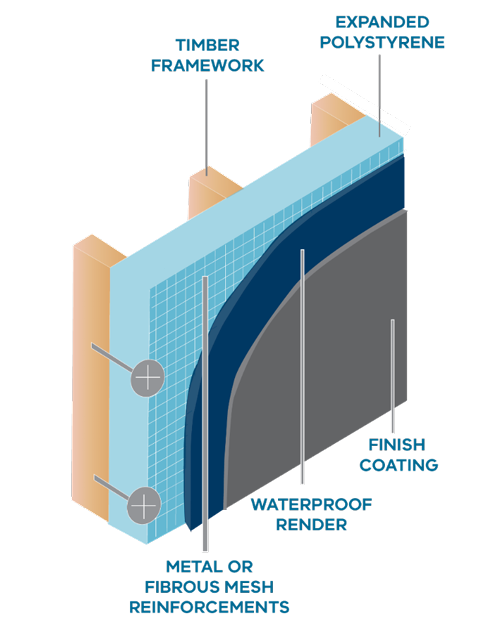
Rendered EPS cladding
Layered system showing timber framing, EPS insulation boards, reinforcing mesh, waterproof render, and a protective finish coat for durability and weather resistance.
1Warringtonfire: Reaction-to-fire report. A reaction-to-fire test of a non loadbearing external wall system in accordance with BS 8414-2:2015+ A1:2017 and Classification report. Classification of a non-loadbearing external wall system in accordance with AS 5113:2016 Amendment 1.
2Fire test witness and review Report – CSIRO: Rendered expanded polystyrene clad wall system AS 5113 external wall fire spread test.
If you have a query regarding the content of this document, please email technicalenquiry@bpc.vic.gov.au or phone 1300 815 127.