
Was this page helpful?
Your rating will help us improve our website.





Cross connections in drinking water supplies Practice Note
The purpose of this practice note is to provide guidance to clarify some of the plumbing issues associated with cross connections in drinking water supplies.
The content provides guidance on:
For guidance on the plumbing regulatory framework, refer to Plumbing Practice Note RF-01 Regulatory Framework.
Backflow is the unintended reversal of flow into the drinking water supply which can occur under conditions of backpressure or back siphonage. Backflow can be prevented by installing mechanical backflow prevention devices. Backflow prevention devices can either be testable or non-testable depending on the application.
A cross connection is any connection between a drinking water supply system either directly or indirectly and any non-drinking supply or other substance which could result in contamination of the drinking water supply system.
Back-siphonage occurs when a reduction in upstream pressure which results in the downstream pressure being greater forcing back liquid. For example, this can happen when a pipeline breaks or there is a sudden drop in mains pressure, which may draw contaminated water into a potable system.
Back-pressure occurs when downstream pressure exceeds the supply pressure, resulting in a reversal of the normal flow direction. This condition is typically caused by factors such as pumps, elevated systems, or thermal expansion within the downstream installation.
Hazard ratings for backflow and cross-connections are in NCC Volume 3, Part B5 - Cross connection control.
See B5D7 Cross-connection hazards:
When a situation arises that is not referenced in B5D7, the verification method B5V1 can be used to determine the hazard rating. A performance solution is required when using the verification method.
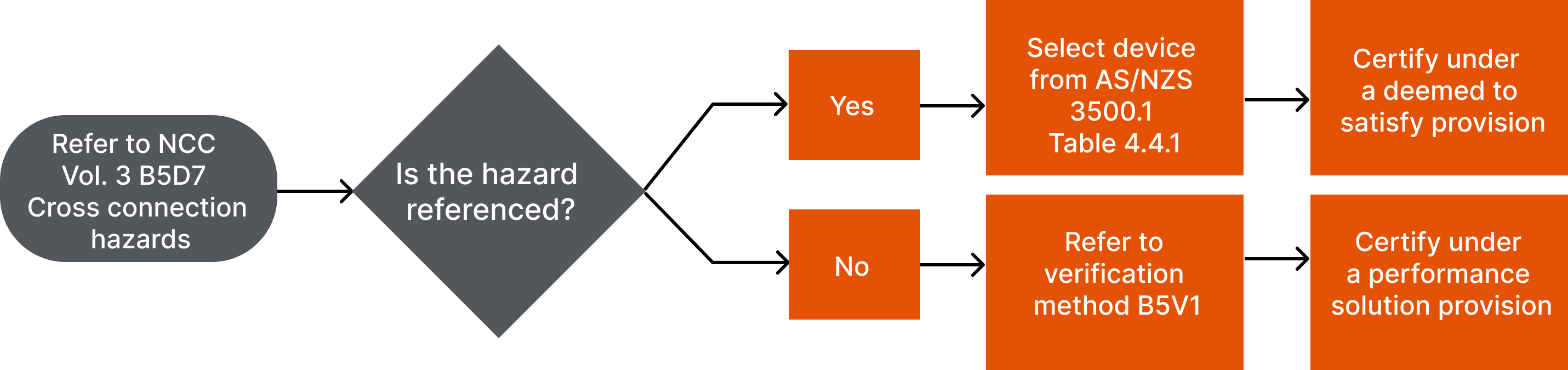
Hazard reference decision tree.
The verification pathway cannot be used for the lowering of any hazards that are already referenced in B5D7.
Cross connections are rated into 3 degrees of hazard for cross contamination of drinking water:
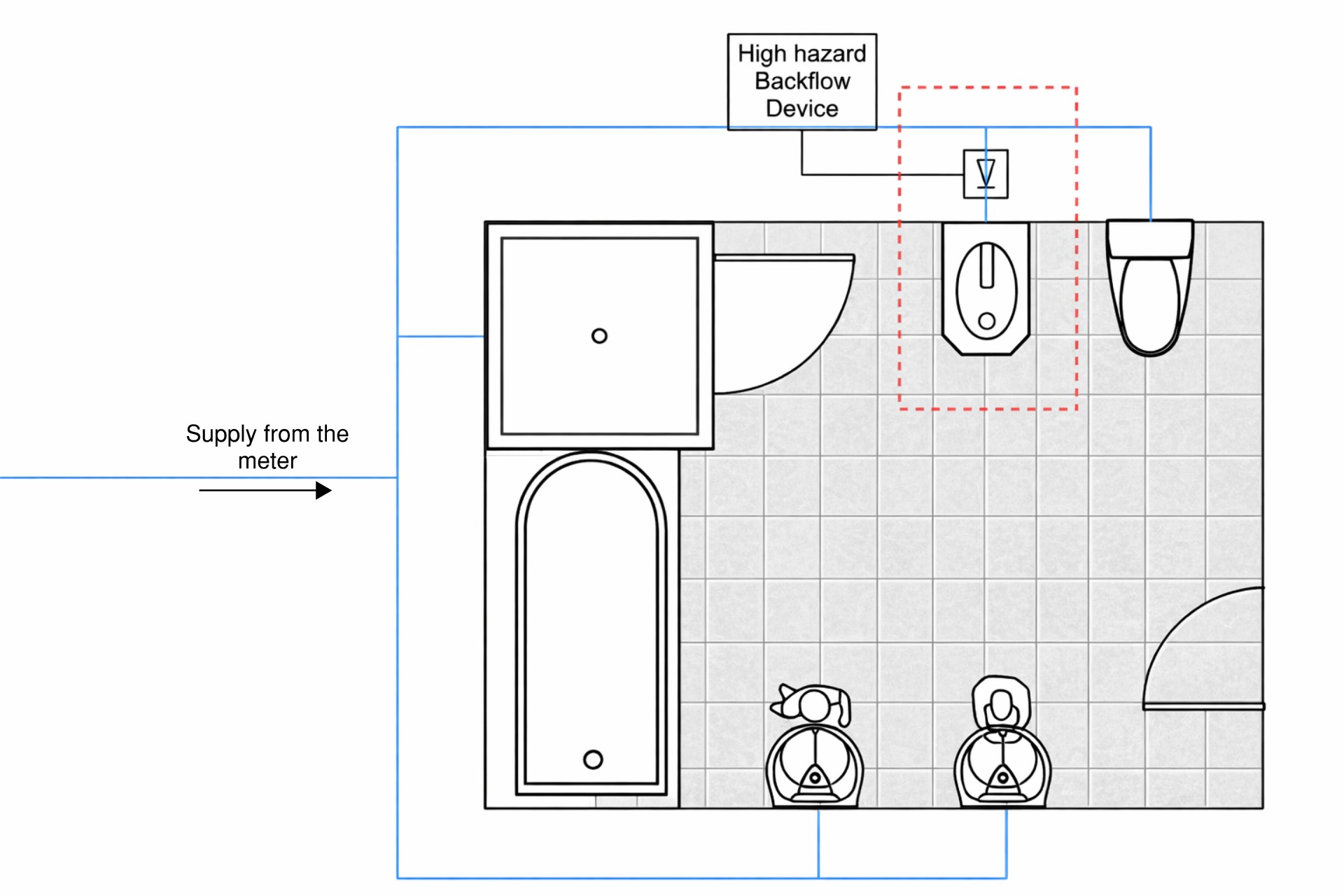
Figure 1. Individual high hazard backflow device at the source of an individual cross connection (e.g. at the fixture)
The installation of a backflow prevention device at the point where a water service is connected to multiple fixtures or appliances, with no backflow prevention device installed as individual protection downstream of this point.
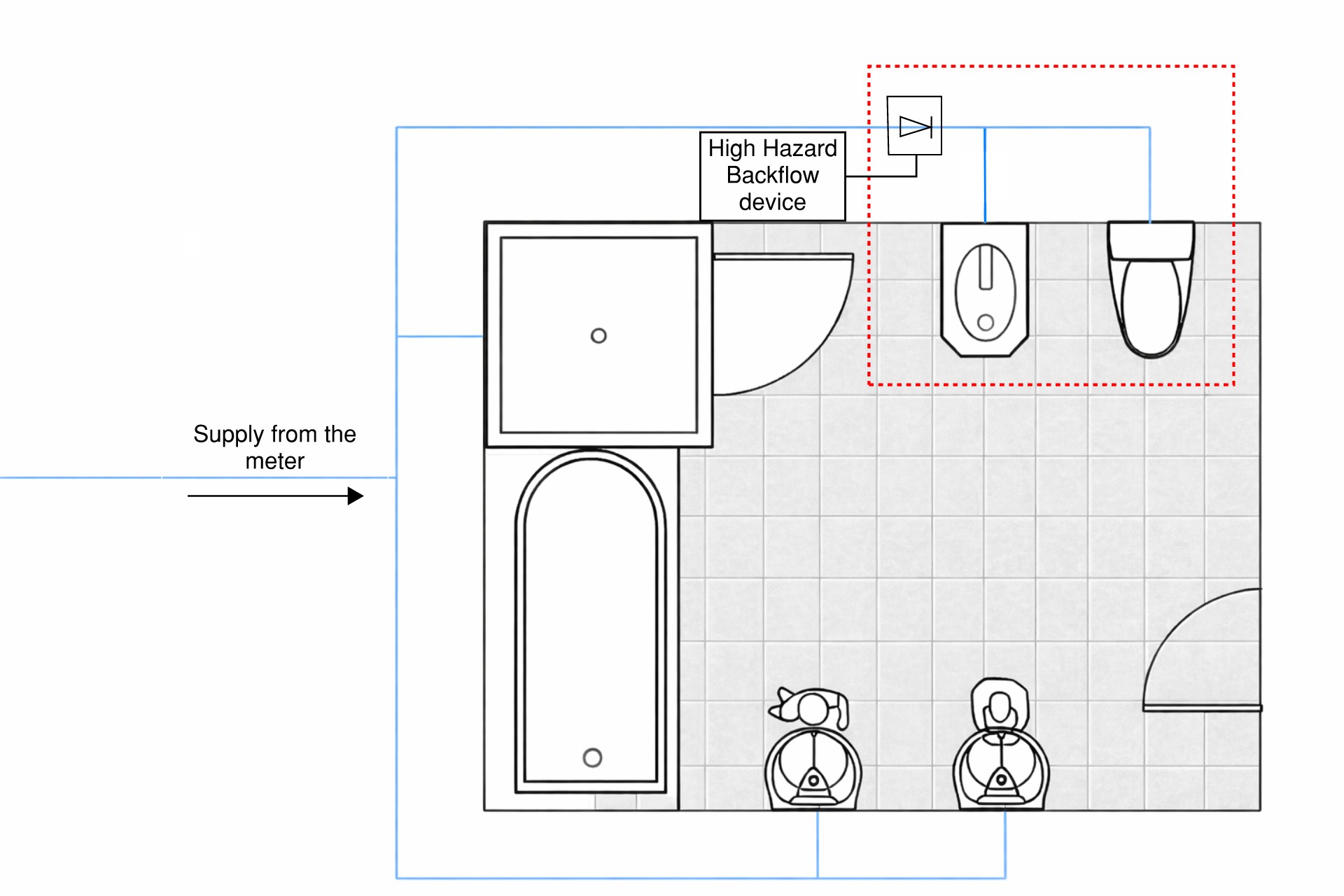
Figure 2. Installation of a backflow prevention device at the point where a water service is connected to multiple fixtures or appliances, with no backflow prevention device installed as individual protection downstream of this point.
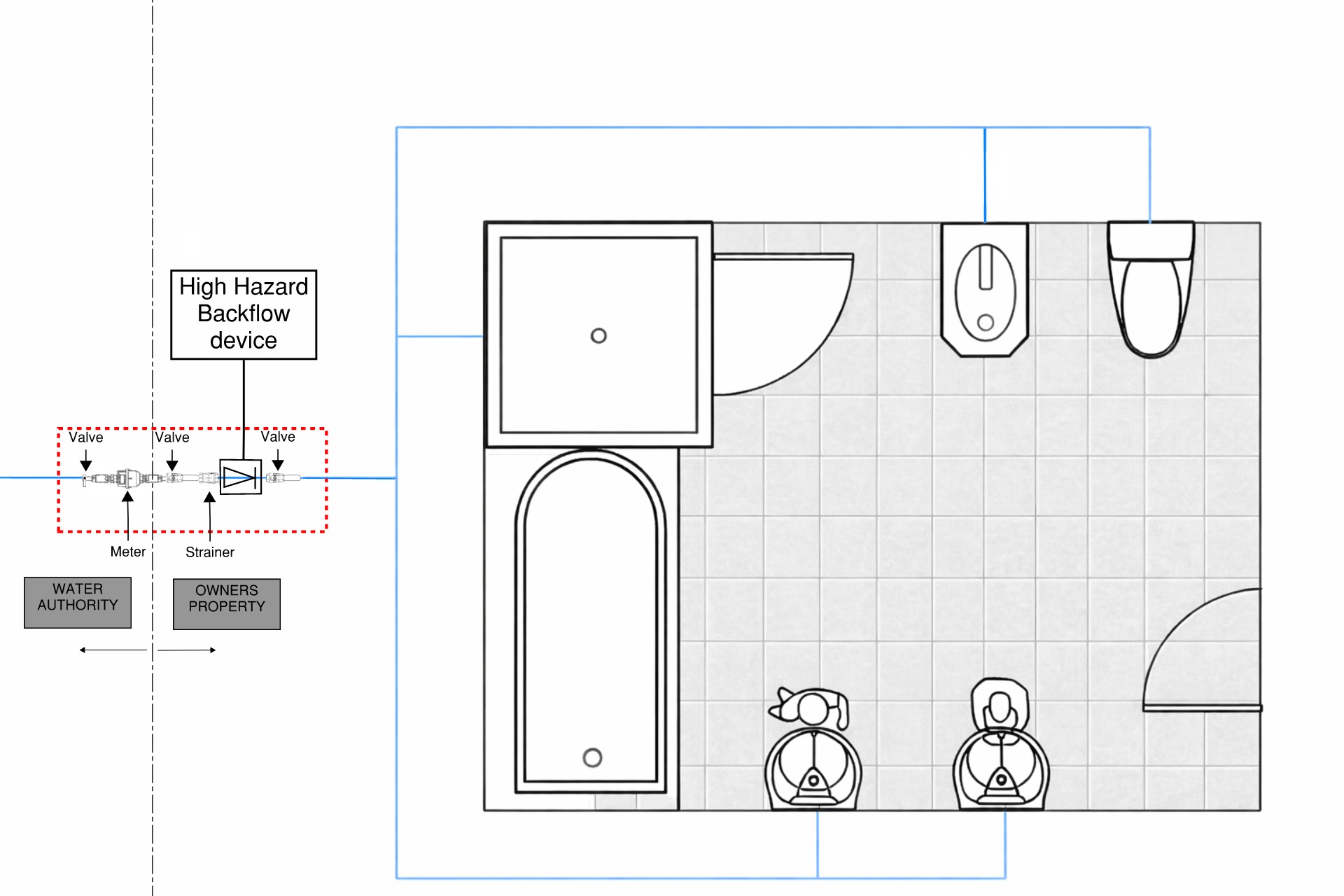
Figure 3: The installation of a backflow prevention device at the point of connection of a Network Utility Operator’s water supply to a site.
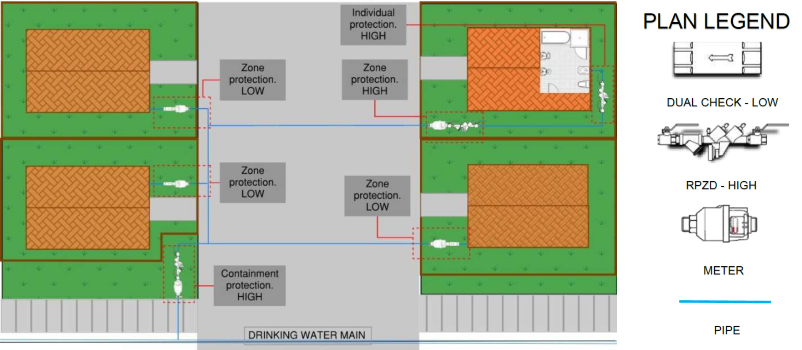
Figure 4: Example of a multi unit development property with low – high hazard protection for cross connections.
Note: This is an example only and must be used with site specific certification and applications.
Table 4.4.1 of AS/NZS 3500.1 outlines the suitability of backflow prevention devices, categorising them as either testable (registered) or non-testable devices.
Backflow prevention devices must be selected and installed strictly in accordance with:
A device rated for a low hazard must not be used where a high hazard exists. In such cases, an appropriate high hazard-rated device must be installed to ensure adequate protection of the potable water supply.
Additionally, certain devices are application specific. For example, devices approved for fire service systems are to be used only on fire services and not for general plumbing applications.
Failure to comply with these requirements may result in inadequate backflow protection and non-compliance with the standard.
It is the property owner’s and owners’ corporations’ responsibility to ensure that all testable devices are inspected and tested annually. Practitioner’s installing testable backflow devices inform the property owner of their responsibility to have the device tested.
Containment protection is located at the property boundary, downstream of the main water meter. Its purpose is to prevent backflow and protect the Network Utility Operator’s water supply from contamination originating within the property.
The requirements for containment protection are ultimately determined by the Network Utility Operator.
The selection of the containment backflow prevention device is based on the level of hazard present within the property, the property classification, and proposed on-site water use, whichever is greater and is at the discretion of the Network Utility Operator.
All potential cross connections and hazards within the property must be identified through an assessment. Where a cross connection is identified, appropriate backflow prevention must be provided in accordance with the assessed level of risk.
Once installed, the containment backflow prevention device registration, commissioning test report and then ongoing annual test report is required to be submitted to the Network Utility Operator who hold the repository and manage the register for containment backflow test reports.
Containment protection is not a substitute for required zone or individual backflow protection within the property.
Where a cross connection exists within the installation, backflow prevention must still be provided at the appropriate point in the system in accordance with the assessed hazard and the requirements of NCC Volume 3 and AS/NZS 3500.1, in addition to any containment protection required by the Network Utility Operator.
When hazards are identified, the practitioner is required to contact the relevant water Network Utility Operator as the type of containment protection may be different to what is installed onsite.
Backflow prevention devices may only be installed by plumbers who hold an appropriate Water Supply Licence or Registration.
All installations must comply with Section 4 of AS/NZS 3500.1.
A compliance certificate is required where the total cost of the installation is $750 or more. Where the hazard rating for any cold, heated non-drinking water installation is assessed as Medium or High with a testable device installed, or a fire service which is rated as testable Low hazard device, the licensed plumber must record the backflow prevention device and hazard details on the compliance certificate.
Backflow prevention devices are classified as either testable or non-testable. A testable backflow device should only be installed with an Annual Maintenance and Test Program. These devices can be tested in situ.
The commissioning, maintenance, initial testing, and annual retesting of any testable backflow prevention device may only be carried out by a person who holds or works under the supervision of a licence in the specialised class of Backflow Prevention Work.