
Please note: Buildings can have mixed uses or be designed to serve multiple purposes. Refer to the National Construction Code for further information.
Was this page helpful?
Your rating will help us improve our website.





Building classifications under the National Construction Code (NCC) are as follows:

Is a dwelling. This class includes two sub-classifications:
Class 1a: A single dwelling being a detached house, or one of a group of attached dwellings separated by a fire-resisting wall (e.g. a terrace house or townhouse).
Class 1b: A boarding house, guest house or hostel with not more than 12 occupants and a floor area not exceeding 300 m²; or 4 or more single dwellings on one allotment used for short-term holiday accommodation. (no floor area limit)
Note: Class 1 dwellings cannot be located above or below another dwelling or building class (except a private garage).
This class of building contains two or more sole-occupancy units (SOU), where each unit is treated as a separate dwelling.
A class 2 building may be a single storey attached dwellings with common space below the dwellings.
Example: Residential apartment buildings.

This class of building is a residential building (other than Class 1, 2 or 4) providing long-term or transient accommodation for unrelated people.
A Class 3 building may include the following:
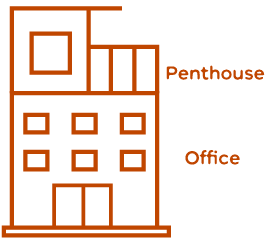
Is a single dwelling located within a building of non-residential nature (Class 5–9).
A Class 4 example: Accomodation over or otherwise connected to a shop. There can only be one Class 4 dwelling in a building.
Is a building used for professional or commercial purposes.
A class 5 building may include the following:
Note: Medical Clinics with patient treatments causing unconsciousness and or temporary ambulatory deficiency is classed as 9a.

These are buildings where goods are sold or services are provided directly to the public.
A Class 6 building may include:
Note: Service stations are Class 6 buildings. These are outlets used for the servicing of cars and the selling of fuel or other goods.
The expression ‘service station’ is not intended to cover buildings where panel beating, auto electrical, muffler replacement, tyre replacement and the like are solely carried out. Such buildings should be classified as Class 6, Class 7 or Class 8 buildings as the appropriate authority sees fit.
This is for a storage type building.
This class includes two sub-classifications:
Class 7a: carparks
Class 7b: a building that is used for storage or display of goods or produce for sale by wholesale. Such as a warehouse.

Is a building of a public nature.
Class 9 includes the following sub-classifications:
Class 9a: a health-care building including any parts of the building set aside as laboratories and includes a health-care building used as a residential care building.
For example: Hospitals, Day surgery clinics
Class 9b: an assembly building including a trade workshop or laboratory in a primary or secondary school. For example: Schools, universities, sports facilities, night clubs, train stations.
Class 9c: a residential care building such as an aged care. Residential care building is define as a Class 3, 9a or 9c building which is a place of residence where 10% or more of persons who reside there need physical assistance in conducting their daily activities and to evacuate the building during an emergency (including any aged care building or residential aged care building) but does not include a hospital.
Is a building or structure that is non-habitable.
Class 10 includes three sub-classifications:
Class 10a: is a non-habitable building such as a private garage, carport or shed.
Class 10b: is a structure that is a fence, mast, antenna, retaining walls, free standing wall or swimming pool.
Class 10c: is a private bushfire shelters
Please note: Buildings can have mixed uses or be designed to serve multiple purposes. Refer to the National Construction Code for further information.