
Was this page helpful?
Your rating will help us improve our website.





Our Building Documentation Audit Program (BDAP), previously referred to as the Building Surveyor Audit Program, is in place to monitor that regulatory requirements are met for building work in Victoria.
The program involves desktop reviews of documentation related to building work in Victoria, including administrative and technical documentation, to verify that registered building practitioners are carrying out their functions correctly and that a quality-built environment is maintained. Our Building Audit team includes highly skilled and experienced registered building surveyors along with other industry practitioners, such as endorsed building engineers. This team undertakes audits of both domestic and commercial work.
By proactively auditing documentation related to building work, we:
Technical Documentation Audits are aimed at identifying and reducing non-compliant building work in Victoria. The program focuses on technical aspects and compliance with the National Construction Code. It involves a review of building and occupancy permit documentation.
A harms-based approach is taken to the technical audits, aligning with our regulatory priorities .
A Building Audit Report is generated for each audit. Non-compliant items are identified and brought to the attention of the RBS. A response may be required for high-risk items to determine how compliance was assessed before the permit was issued.
The RBS guide provides information on response requirements.
Sites and practitioners are selected based on a risk-based framework or intelligence from a range of sources.
Building permit data is used to identify suitable audit targets, with risk factors applied to prioritise sites.
Particular construction types and practitioners may also be targeted to manage risk and enable early intervention where required.
Four elements are considered to determine compliance:
Three compliance levels relate to the sufficiency of information:
An item is compliant when sufficient information demonstrates that requirements are met through DtS or a performance solution.
An item is unable to be determined when insufficient information is available to assess compliance.
An item is non-compliant when documentation shows a clear failure to meet requirements.
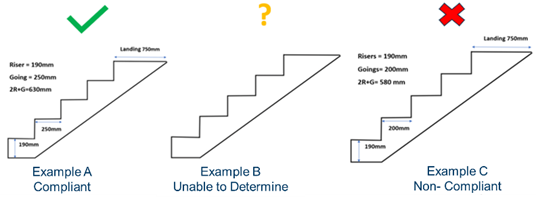
Figure 1. Compliance Levels
Regulation 47 requires building surveyors to provide certain information each month, including permits that have lapsed, final inspection details, occupancy permits and Certificates of Final Inspection (CFI).
Information on reporting requirements is available on the BAMS homepage. The Reporting Prescribed Events fact sheet provides further detail on Regulation 47 requirements.
The Building Practice Note BP-07 Time limits for building work and lapsed building permits outlines time limits for building work, permit extensions and lapsing of permits to support compliance with the Act and Building Regulations 2018.
Regulation 47 Administrative Audits involve reviewing building permit data in BAMS to identify information that has not been correctly reported or recorded. This may include permits that:
These audits help ensure accurate record-keeping and that permits remain appropriately assigned, even if a building surveyor is no longer able to perform their functions.
Where reporting requirements have not been met, the building surveyor will be notified and required to correct the information in BAMS.
If the result is Fail:
If the result is Pass:
Call us on 1300 067 088 or email us.