
Was this page helpful?
Your rating will help us improve our website.





Building Practice Note
Published 18 May 2026 | Version 2.0
This practice note provides clear advice and guidance on fire bolts. This includes providing information to support the industry moving forward, to understand:
Fire bolts, also referred to as heat-activating, thermal or fire pins, are devices which are typically recessed into the door leaf and activate during exposure to temperature, as a result, fixing and securing the fire door leaf to the frame.
Fire bolts are used to help meet the Fire Resistance Level (FRL) criteria in the BCA and in accordance with AS 1530.4 – 2014, Methods for Fire Tests on Building Materials, Components and Structures – Part 4: Fire-Resistance Test of Elements of Construction.
Image produced by BPC
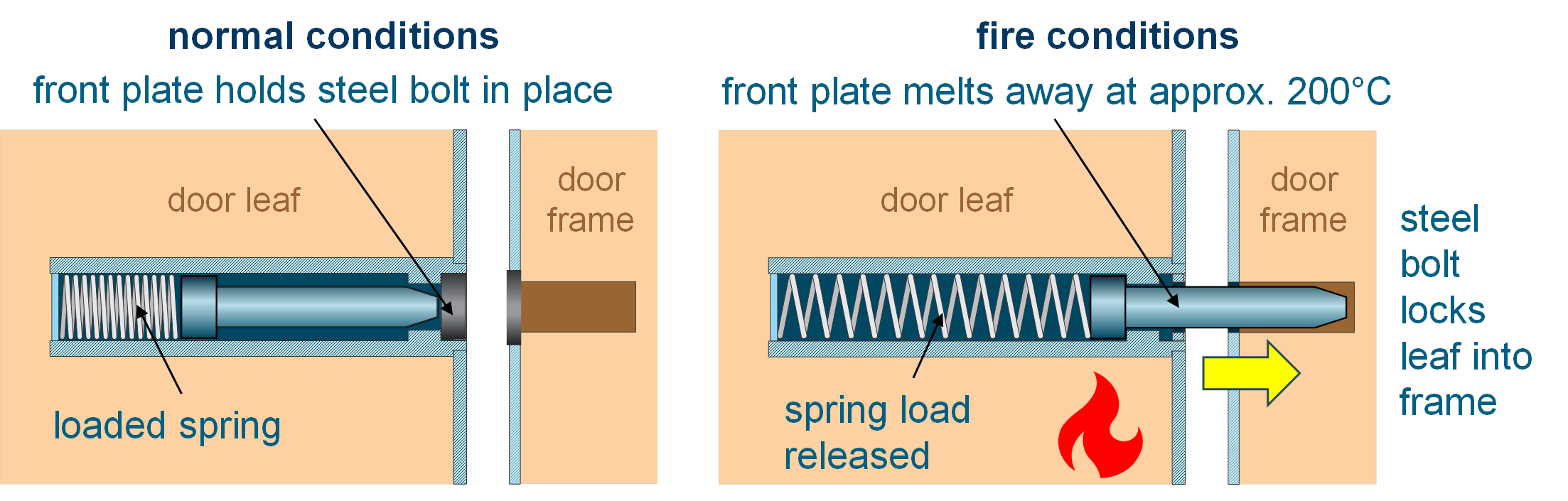
The main risks associated with fire doors fitted with fire bolts relate to:
Fire bolts can obstruct fire door functionality from either:
Caution must be applied by all parties involved in the design and construction process before deciding to use fire doors fitted with fire bolts.
In Australia, there is no defined standard of construction, testing, manufacture or maintenance for fire bolts in fire doors. This leads to uncertainty around the performance of fire bolts in doors, as there are no clear design guidelines or understanding about what can be expected from these devices.
Whilst these devices are generally understood to activate at temperatures above 200 degrees Celsius, this is not definitive as there is no adopted standard for their design or use.
As fire bolts are often located at the upper part of the door, the risk of occupant entrapment can be high, where bolts could be activated by the hot smoke layer whilst occupants are still evacuating within a tenable egress route.
Regulation 228 of the Regulations requires the maintenance of exits and paths of travel in certain buildings. This regulation requires that all exits and paths of travel to exits in buildings are kept readily accessible, functional and clear of obstructions so that egress from the building is maintained. Therefore, the requirement of Regulation 228 cannot be met when the use of fire doors fitted with fire bolts have not been justified via a performance solution or a Building Appeals Board (BAB) determination.
Principle 1 of the Code of Conduct for Building Surveyors requires building surveyors to act in accordance with the law and in the public interest. Where there is doubt as to the interpretation of legislation, the BCA or standards, building surveyors are required to prefer the interpretation that best serves the objectives of the Act and the public interest. The objective of Section 4(1)(a) of the Act is to protect the safety and health of people who use buildings.
When interpreting the BCA with respect to fire doors fitted with fire bolts, the interpretation that best serves the objectives of the Act is to conclude that they do not comply with Clause D3D26 of the BCA.
Builders, building designers, architects and engineers must be cognisant of any Code of Conduct and statutory professional conduct obligation that applies to their profession.
Fire doors must comply with several relevant BCA Performance Requirements, including those in Sections C, D and E, when they are installed in:
Where the DtS Provisions of the BCA requires a FRL, A5G5 of the BCA mandates that this is determined in accordance with Specifications 1 and 2. For a door that requires a FRL, this is a prototype that has been submitted to AS 1530.4 and is confirmed in a report from an Accredited Testing Laboratory (ATL). Whilst this may satisfy some requirements of Section C of the BCA in isolation, there are other requirements that are relevant and need to be considered.
The DtS Provisions of Clause D3D26 of the BCA are not met when using fire doors fitted with fire bolts. Therefore their use must be approved via a Performance Solution or subject to a BAB determination. Any Performance Solution must address all relevant Performance Requirements.
Performance Solutions must be assessed on a case-by-case basis and may not be appropriate in all situations.
Consideration must be given to occupant characteristics, the functions and use of the building, exit locations, fire brigade intervention and the operation of active and passive fire safety systems.
A building permit is required for the installation and replacement of fire doors.
Building Inspectors and Building Surveyors must ensure that the fire doors used in buildings comply with the fire doors specified in the building permit.
The replacement of fire doors in existing buildings requires a building permit as there is no exemption in Schedule 3 of the Regulations for this type of work. The installation of the new fire doors is to be undertaken in accordance with the building permit and approved documents.
Where fire doors fitted with fire bolts have been identified as being installed in an existing building without the use of an appropriate Performance Solution, or a BAB determination, they are non-compliant with Regulation 228 of the Regulations and the DtS Provisions of the BCA. They should be replaced with a compliant installation under a new building permit.
As part of essential safety measure (ESM) maintenance, where fire bolts are identified in fire doors without appropriate Performance Solutions or a BAB determination, the Municipal Building Surveyor (MBS) of the relevant Council should be notified as soon as practicable. It is recommended the MBS may carry out an inspection and undertake relevant enforcement activities, that may include issuing a building notice/building order or emergency order.
Where a building is under construction, all relevant parties should ensure that any fire door is installed in accordance with the DtS Provisions of the BCA, unless there is an approved Performance Solution, or a BAB determination that addresses the use of fire doors fitted with fire bolts.
Builders must ensure that door systems are installed in accordance with the approved building permit and documentation. Substitution of products is not acceptable or permitted and is a breach under s16(4A) of the Act, unless approved prior to the installation or use by the Relevant Building Surveyor in an amended building permit.
Engineers, architects and designers are responsible for documenting compliant designs and specify products that satisfy the Regulations and BCA and must provide the required evidence of suitability.
Section 24 Act states that: The RBS must not issue a building permit unless he or she is satisfied that the building work and the building permit will comply with the Act, Regulations and any binding determination that applies to the carrying out of the building work.
An RBS may consider a determination of the Building Appeals Board (BAB) or a performance solution submitted with the building permit application.
Building work must be carried out in accordance with the Act, Regulations and the building permit issued.