
Was this page helpful?
Your rating will help us improve our website.





Smoke alarms are compulsory and must be installed in every residential building, on or near the ceiling of every storey.
Residential buildings include the following building classes as broadly defined in the National Construction Code (NCC):
Smoke alarms need to be positioned to wake sleeping occupants. They must be located between each bedroom area and the rest of the house.
Victoria’s fire services (CFA and FRV) recommend that additional smoke alarms also be installed in every bedroom and living area for the best safety of occupants.
They should be installed on the ceiling at least 30cm from the wall, or where installed on the wall at least 30cm from the ceiling to avoid dead air space.
Smoke alarms must meet the Australian Standard AS 3786 and complying models can be found at most electrical appliance or hardware stores.
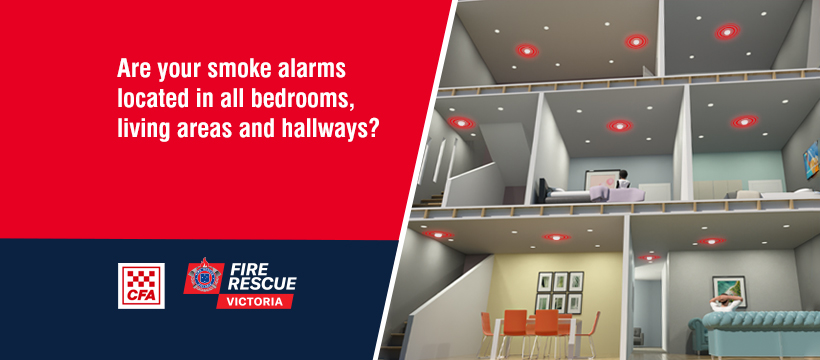
Are your smoke alarms located in all bedrooms, living areas and hallways?
Homes constructed after 1st August 1997 must have smoke alarms connected to 240V mains power and have a backup battery. Homes constructed before 1st August 1997 may have smoke alarms powered by a battery.
CFA and FRV recommend the use of smoke alarms powered by a ten-year lithium battery that last the life of the smoke alarm unit.
Smoke alarms should also be interconnected, so that when any alarm activates, all smoke alarms will sound.
Interconnected smoke alarms can be:
If you are renting a house or unit, it is the landlord's responsibility to ensure smoke alarms are installed and kept in working condition.
Regardless of whether you are renting or living in a home that you own, you should:
A fine can be imposed on an owner who fails to comply with the smoke alarm requirements of the Building Regulations 2018.