
Was this page helpful?
Your rating will help us improve our website.





On 17 April 2025, Standards Australia published AS/NZS 3500:2025 plumbing and drainage to replace the 2021 edition. It is a referenced standard in the Plumbing Code of Australia, which is adopted under the Plumbing Regulations 2018.
Plumbing practitioners must ensure all plumbing work commenced on or after 20 October 2025 complies with the 2025 version of the standard.
Broadly, the key changes in the 2025 edition of AS/NZS 3500.2 are:
| Clause 1.1 Scope | (Update to clause) Updated text: AS/NZS 3500.2 does not apply to the pre-treatment of trade wastes.
|
|---|
| Clause 13.21 Connection of tundishes | (Update to clause)
|
|---|
| Clause 13.24.2.1 General | (Update to clause)
|
|---|
| Clause 13.24.2.3.2 Installation | (New clause) – The below is a new requirement. Waterless wall-hung urinals shall be connected directly to a soil stack or a drain. The outlet from the integral cartridge seal or integral self-sealing mechanical device shall be connected to an individual discharge pipe not smaller than DN 65. The individual discharge pipe shall be graded at not less than 5 % to a: (a) soil stack (b) common discharge pipe or drain. Note: These requirements are illustrated in Figure 13.24.2.3.4(A). |
|---|---|
| Clause 13.24.2.3.3 Fixture discharge pipes | (New clause) – The below is a new requirement. The connection of fixture discharge pipes from waterless urinals shall meet the following requirements: (a) The length of the graded section of the individual discharge pipe between the sealing device and the vertical dropper shall be no greater than 300 mm. (b) The dropper from the urinal shall be vertical or inclined at not more than 45 ° from the vertical as shown in Figures 13.24.2.3.4(C) and 13.24.2.3.4(D). |
| Clause 13.24.2.3.4 Common discharge pipes | (New clause) – The below is a new requirement. 13.24.2.3.4 Common discharge pipes The connection of waterless urinals to common discharge pipes shall meet the following requirements: (a) 45 ° junctions shall be used to connect individual discharge pipes to a common discharge pipe or drain. The entry level of the junction shall be elevated at a minimum incline of 20 ° and a maximum incline of 45 ° above the horizontal as shown in Figures 13.24.2.3.4(C) and 13.24.2.3.4(D). (b) Common discharge pipes shall be no less than DN 65. (c) Common discharge pipes shall have wastewater equivalent to one fixture unit discharge for each waterless urinal connected to the common discharge pipe upstream of waterless urinals. (d) If the requirements of Item (c) cannot be met, an approved flushing device shall be installed upstream of waterless urinals. (e) Common discharge pipes shall not be smaller than DN 100 when water closet pans are connected upstream. Note 1: Common discharge pipes should be graded between 3.35 % and 6 %. Note 2: The requirements of Items (a) to (e) are illustrated in Figures 13.24.2.3.4(A) to 13.24.2.3.4(G). |
| Clause 13.24.2.3.5 Access | (New clause) – The below is a new requirement for wall-hung urinals discharge pipes. Inspection openings shall be provided for: (a) individual discharge pipes (b) common discharge pipes. Note: See clause 10.5 for requirements for inspection openings. |
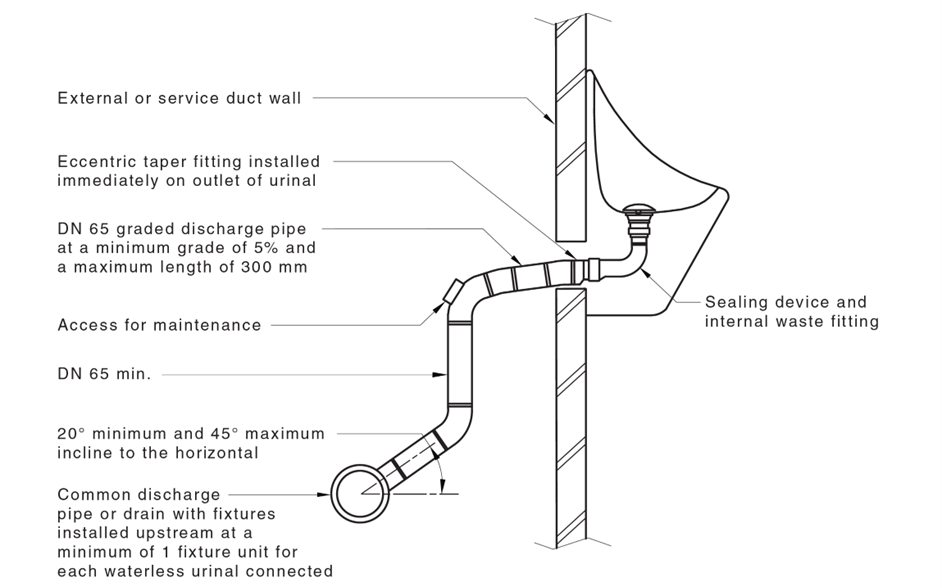
Figure 13.24.2.3.4(A)
Connection of waterless urinals on grade to common discharge pipes or drains external to the building or in a service duct (side view).
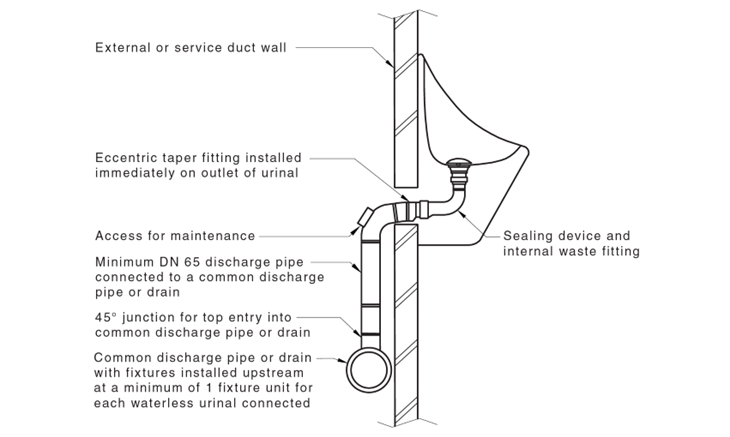
Figure 13.24.2.3.4(B)
Connection of waterless urinals with 45 ° top entry to common discharge pipes or drains (side view)
Note 1: For a DN 65 discharge pipe connected to a common discharge pipe or drain, see Figure13.24.2.3.4 (A)
Note 2: The minimum top entry angle shall be as specified in Clause 13.24.2.3.4(a).
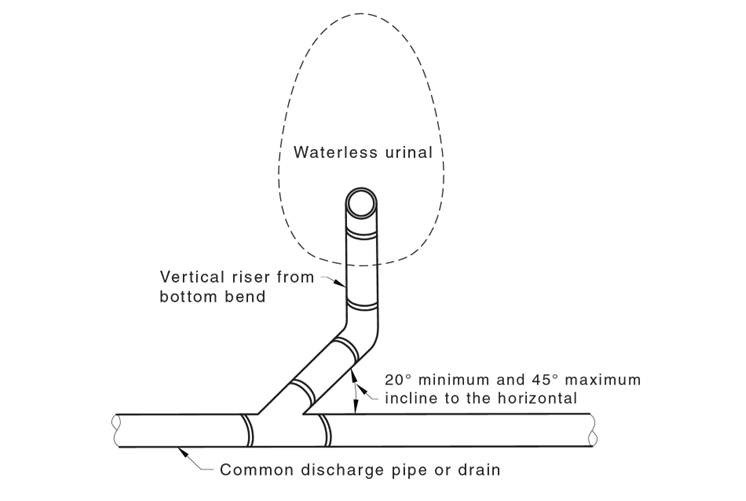
Figure 13.24.2.3.4(C)
Connection of waterless urinals on grade to common discharge pipes or drains (rear view).
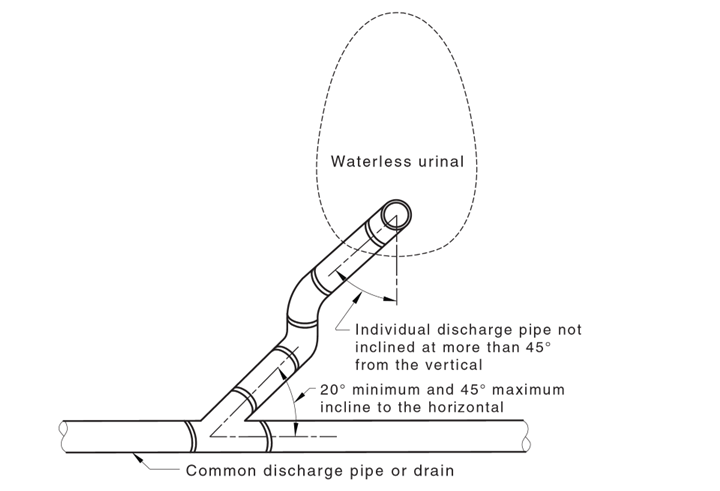
Figure 13.24.2.3.4(D)
Alternative connection of waterless urinals on grade to common discharge pipes or drains (rear view).
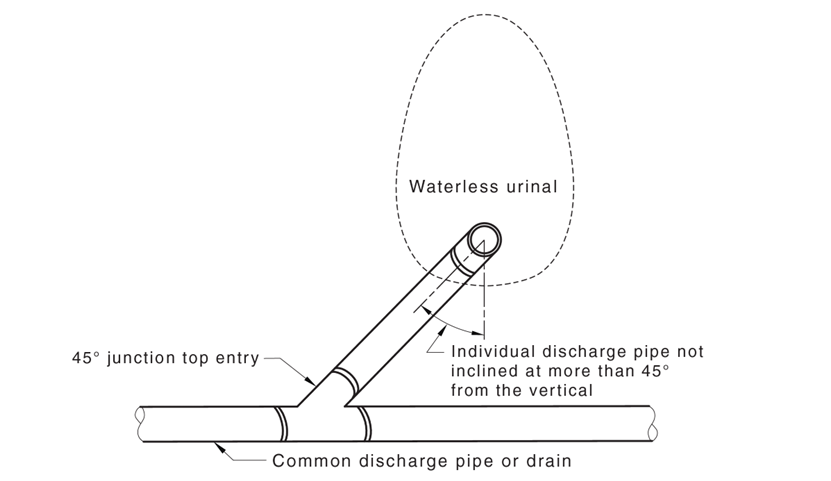
Figure 13.24.2.3.4(E)
Connection of waterless urinals with a 45 ° top entry to common discharge pipes or drains (rear view).
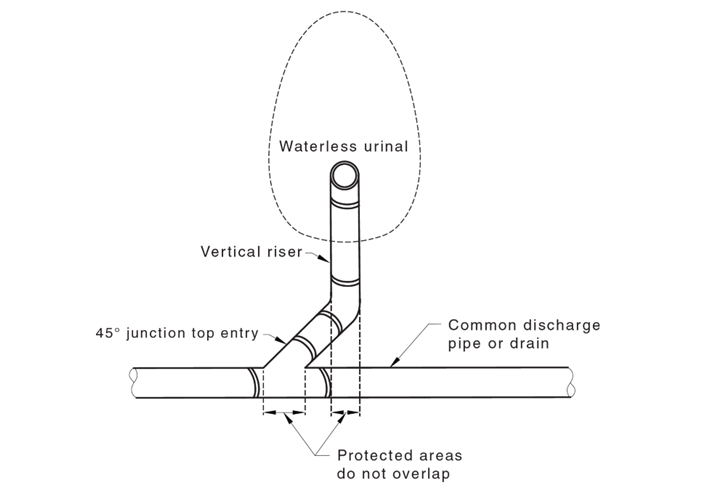
Figure 13.24.2.3.4(F)
Alternative connection of waterless urinals with a 45 ° top entry to common discharge pipes or drains (rear view).
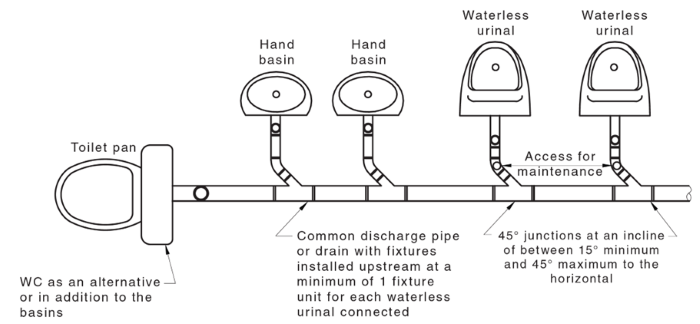
Figure 13.24.2.3.4(G)
Connection of fixtures upstream of waterless urinals.
Key
WC = water closet
Note: The figure doesn't show venting requirements.
| Clause 13.24.3 Conversion to waterless urinals | (Update to clause)
|
|---|
| Clause 13.28.1 General | (New clause) – There are new requirements for the connection of miscellaneous devices and appliances to a sanitary drainage system. This section specifies sanitary plumbing and drainage system requirements for miscellaneous devices and appliances that produce wastewater as part of their function. Note: The quality, quantity and temperature of the wastewater discharge from devices and appliances should be considered as it may impact the sanitary plumbing and drainage system, network utility operator infrastructure or an on-site wastewater management system. Wastewater discharge may require approval and/or pre-treatment as determined by the relevant authority. |
|---|---|
| Clause 13.28.2 Materials | (New clause) – The below is a new requirement. Pipes and fittings connected to miscellaneous devices and appliances shall meet the requirements of Section 2. |
| Clause 13.28.3 Connections to the sanitary system | (New clause) – The below is a new requirement. Discharge shall enter the sanitary system by either: (a) direct connection to a dedicated trap connection (b) a tundish as specified in clause 13.21. |
| Clause 13.28.4 Intermittent discharge | (New clause) – The below is a new requirement. If the frequency of discharge from appliance or device is not sufficient to maintain a trap seal, the wastewater discharge shall drain over a tundish with either a: (a) charge pipe from a tap set (b) drain from a water heater expansion control valve (c) charge pipe extended from a mechanical or electronic trap priming device. |
| Clause 13.28.5 Large-volume discharge | (New clause) – The below is a new requirement. A sanitary system shall: (a) be of a size suitable for the expected discharge volume as specified in clause 6.3 (b) have a trap with: (i) a water seal of not less than 100 mm (ii) an equivalent size to the discharge pipe. Note 1: A trap seal depth suitable for the anticipated discharge volume should be used to maintain the trap seal after a discharge event and prevent the release of sewer gasses. Venting of the sanitary plumbing and draining system shall be: (i) provided in addition to any other existing venting required (ii) as specified in Section 6. Note 2: Venting is an important consideration where large volume discharges occur to avoid hydraulic imbalances within the sanitary plumbing and drainage system. Note 3: Large volume discharges may be considered to be in excess of 2 L per second or acceptable limits to a network utility operator’s capacity. |
| Clause 14.2.1 General | (Update to clause) – A new note has been added. Plumbers must coordinate with water authorities to obtain additional information before installing sewer infrastructure for multi-unit developments: Note: Refer to local government or the network utility operator for additional information on design requirements for sewer infrastructure. |
|---|---|
| Figure 14.2.1 | Figure 14.2.1 – Typical sanitary drainage system for a multi-unit development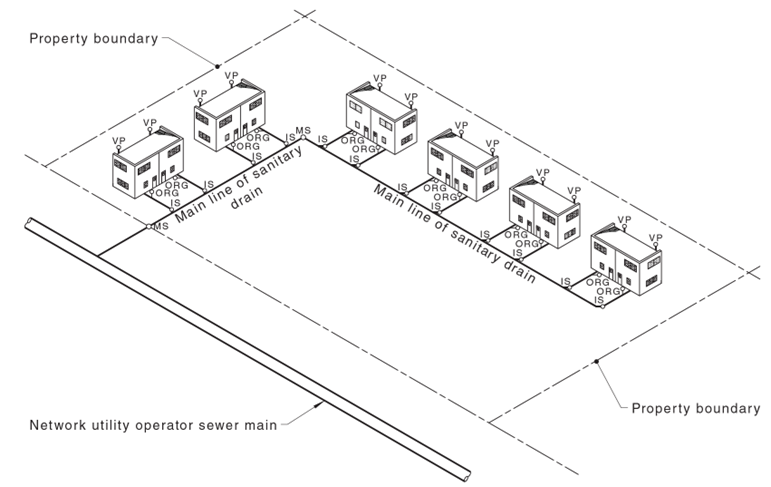 Key: IS = Inspection shaft, see Clause 14.2.2 VP = Open vent pipe, see Clause 14.2.3 ORG = Overflow relief gully, see Clause 14.2.4 MS = Maintenance shaft (for > 20 buildings), see Clause 14.2.5 |
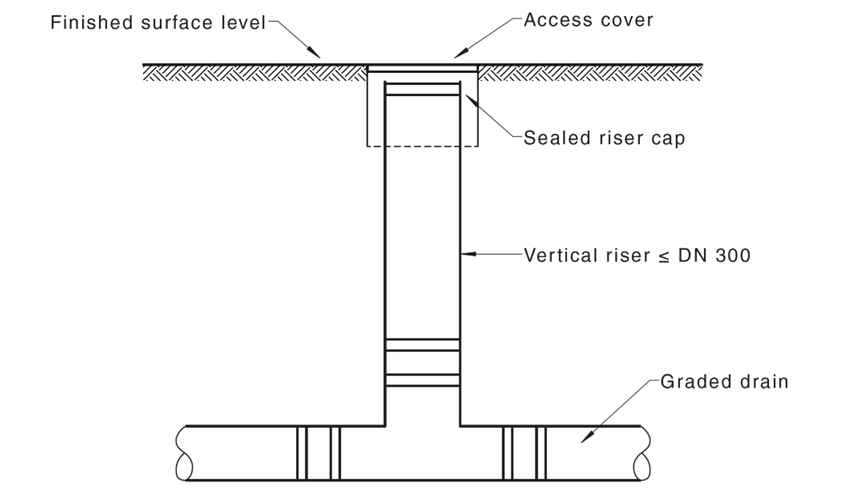
| Figure 14.2.5 | Figure 14.2.5 – Maintenance shaft for multi-unit development
Note: For information on access covers and sealed riser caps for maintenance shafts, see Clause 4.4.2.1 |
| Clause 16.2 Materials and products for vacuum drainage systems | (Update to clause) In the 2025 edition, plumbing practitioners are able to use polypropylene (PP) pipes and fittings with a minimum wall thickness equivalent to pipe series S16 (SDR 33) to construct vacuum pipelines. Vacuum pipelines shall be constructed of one of the following: (e) Polypropylene (PP) pipes and fittings with a minimum wall thickness equivalent to pipe series S16 (SDR 33). Note 6: Refer to the following Standards for more information: (a) AS/NZS 7671 – plastic piping systems for soil and waste discharge inside buildings. (b) AS/NZS 5065 – polyethylene and polypropylene pipes and fittings for drainage and sewerage applications. |
|---|