
Was this page helpful?
Your rating will help us improve our website.





On 17 April 2025, Standards Australia published AS/NZS 3500:2025 plumbing and drainage to replace the 2021 edition. It is a referenced standard in the Plumbing Code of Australia, which is adopted under the Plumbing Regulations 2018.
Plumbing practitioners must ensure all plumbing work commenced on or after 20 October 2025 complies with the 2025 version of the standard.
Broadly, the key changes in the 2025 edition of AS/NZS 3500.3 are:
| Clause 2.2.1 General | (Update to clause) Note 3: has been added to Section 2.2.1. It requires plumbers to consider the quality and quantity of stormwater discharge. This is to ensure it does not negatively impact council infrastructure or on-site systems. |
|---|---|
| Clause 2.2.2 Materials for devices and appliances connected to stormwater drainage | (New clause) – The below is a new requirement. The selection of pipework and fittings shall be based on: (a) anticipated discharge temperature, and Note 1: Temperature limitations of different pipework materials should be considered in relation to continuous and intermitted discharges for continued stability of the pipework and fittings. (b) quality of discharge. Note 2: Consideration should be given to the quality of the discharge as it may impact the pipework used in the stormwater system. |
| Table 3.3.4 Annual exceedance probability | (Update to table) Eaves gutter overflow measures have been added to Table 3.3.4. They must now be designed for at least 1% Annual Exceedance Probability (AEP). |
|---|
| Design procedure – overflow measures | (New clause) – The below is a new requirement. The design of eaves gutter overflow measures must meet the new requirements in this clause and in Appendix F. Appendix F is now a mandatory requirement in the 2025 edition. The clause below has been introduced in the 2025 edition: The design inflow volume Q* (L/s) for overflow design shall be calculated based on: (a) all downpipes assumed to be fully blocked (b) an annual exceedance probability (AEP) as specified in Table 3.3.4 Item (b). The design of overflow measures shall be as specified in Appendix F. The relevant catchment area for overflow design shall be determined as specified in Clause 3.4. The total catchment area shall include both upper and lower catchments if overflow from the upper catchment increases the volume of water to be handled by the lower catchment overflow measures. Overflow measures are not required if eaves gutters are fixed to a veranda or an eave that is greater than 450 mm in width and: (i) has no lining (ii) is a raked veranda or a raked eave with a lining sloping away from the building. Note: Consider the potential interactions of all overflow devices with other building elements and services such as roof membranes, leaf excluders and rainwater harvesting systems. |
|---|
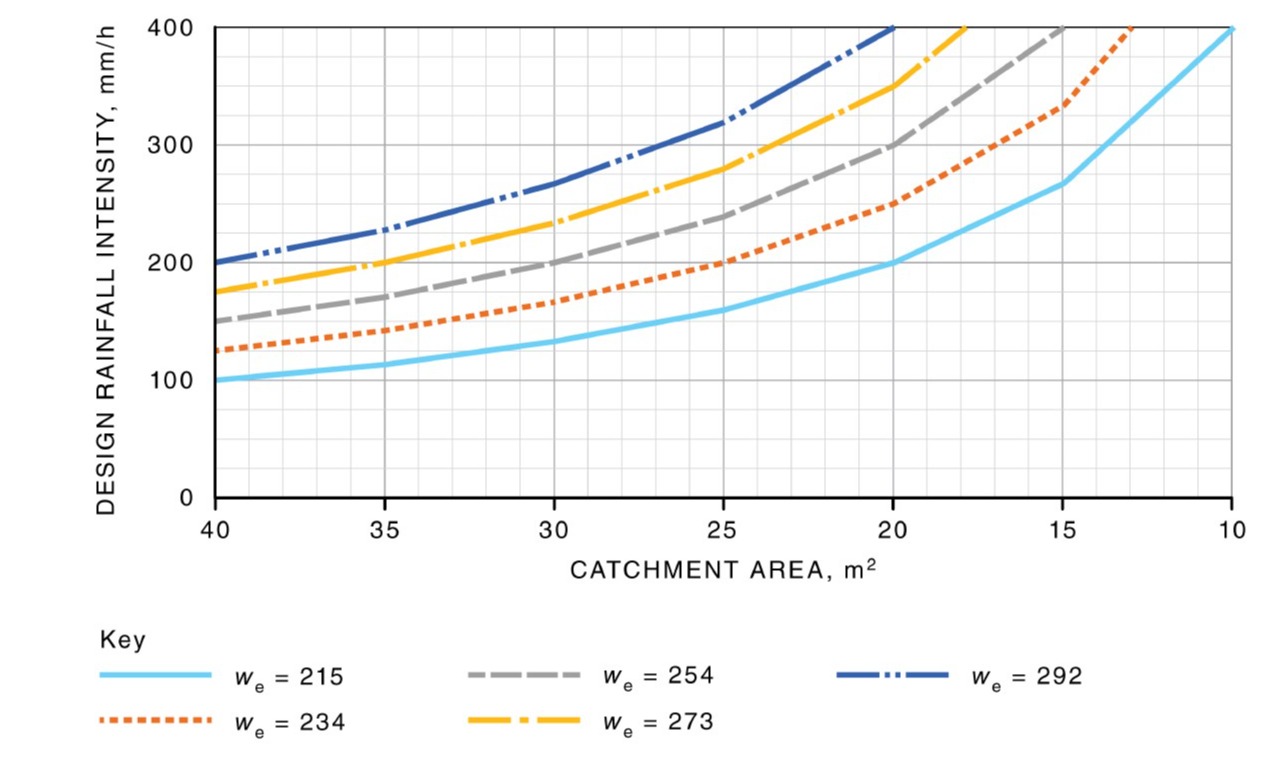
| Clause 3.6.1 Limitations | (Update to clause) The catchment area for valley gutters must meet the limits in Figure 3.6.2. In the 2025 edition, the limit has increased from 20 m² to 40 m². |
|---|---|
| Clause 3.6.2 Design procedure | (Update to clause) A new Figure 3.6.2 has been included to compare design rainfall intensity (DRI) with catchment area for various valley gutter effective widths, now allowing up to 40 m². Figure 3.6.2 — DRI vs catchment area for various valley gutter sizes
Key: EW = Effective width, in mm Note: See Clause 3.6.3 for the effect of obstructions on the effective width of the valley gutter. The effective width of the valley gutter must be calculated using:
An explanatory note has been added indicating that Computational Fluid Dynamics (CFD) may also be used to calculate the effective width of a valley gutter (see clause F.4.5). |
| Clause 5.3.8.1 General | (New clause) – The below is a new requirement. This section specifies stormwater drainage system requirements for miscellaneous devices and appliances that produce discharge water as part of their function. Note 1: The quality, quantity and temperature of the discharge water from miscellaneous devices and appliances should be considered as it may impact the stormwater drainage system, the network utility operator infrastructure, or an on-site wastewater management system. Note 2: Discharge water may require approval, pre-treatment or both as determined by the relevant authority. |
|---|---|
| Clause 5.3.8.2 Stormwater connection | (New clause) – The below is a new requirement. If a device or appliance discharges to a stormwater drainage system: (a) the discharge to the stormwater system shall be via a tundish or pit; and (b) the point of discharge from each drain line shall be located so that the release of steam or heated water does not cause a nuisance, is readily discernible, and causes no risk of damage to the building or injury to people. If a tundish or pit is installed, the point of discharge shall: (i) be in an accessible location (ii) be securely fixed to prevent movement (iii) allow any discharge to be visible to building occupants (iv) maintain a minimum 25 mm air gap. |
| Clause 5.3.8.3 Stormwater system design | (New clause) – The below is a new requirement. The stormwater system shall be sized to allow for the maximum discharge. Note 1: Refer to the manufacturer’s specifications for information relating to anticipated discharge volumes. Note 2: See clause 2.2.2 for information relating to materials. Note 3: Consideration should be given to the quality of the discharge and approval requirements of relevant local authorities. |
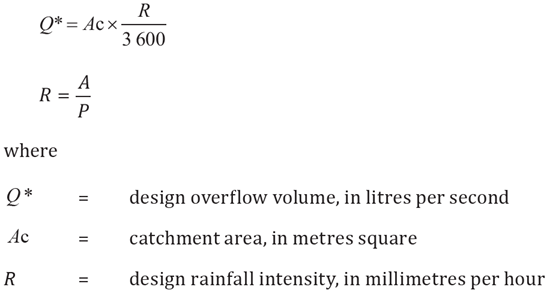
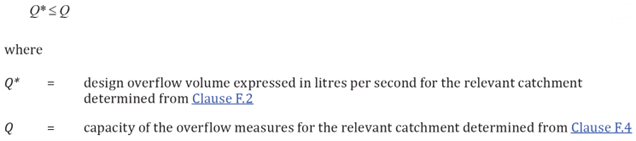
(Normative) | (Update) – Appendix F Appendix F has become normative in the 2025 edition, meaning it is now a mandatory requirement. In the 2021 edition, Appendix F was informative only. Appendix F specifies requirements for design of eaves gutter overflow measures for on roof catchments up to 400 m². Explanatory note: the 400 m² limit represents residential and small commercial buildings. This means that Appendix F does not apply to complex commercial projects. (Update to Appendix F) – The below is a new (mandatory) requirement. F.1 Scope This appendix sets out design procedures for eaves gutter overflow measures on roof catchments up to 400 m². Note: Four hundred square metres is a suitable value for residential and small commercial buildings. F.2 Overflow volume The design overflow volume (Q*) required to be dispersed by overflow measures shall be calculated for each catchment using the design procedure in clause 3.5.3.
Note 1: Table 3.3.4 nominates AEP at 1 % for determining the rainfall rate for overflow design. Note 2: Debris build up in gutters and the presence of snow, hail or ice at the time of peak overflow volume may reduce the effectiveness of all overflow measures and is not considered in the design. F.3 Overflow design Eaves gutter overflow measures for each catchment shall be designed to accommodate the design overflow volume as follows:
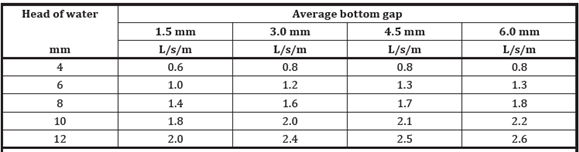
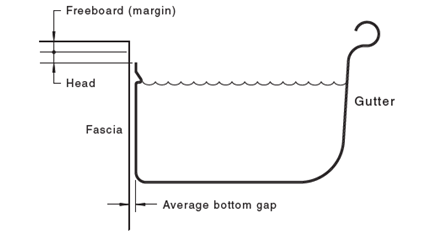
F.4 Continuous overflow measures F.4.1 General Continuous overflow measures for each catchment and eaves gutter element shall be designed as specified in clause F.2 and using one of the measures provided in clauses F.4.2 to F.4.5. For capacity Q for continuous overflow measures for a catchment, the value derived from clauses F.4.2 to F.4.4 shall be multiplied by the length of eaves gutter serving the catchment. The installation of continuous overflow devices shall provide a minimum margin above the maximum head on which the device relies of: F.4.2 Gutter back gap overflow For capacity Q for back gap overflow for a catchment, the value derived from Table F.1 shall be multiplied by the length of eaves gutter (including back gap) overflow serving the catchment. Note: Figure F.1 illustrates the relationship between average bottom gap and head of water. |
| Table F.1 | Table F.1 - Gutter back gap overflow capacity
Note: Average bottom gap is the width of the gap between the gutter and fascia expressed as the average of measurements at 300 mm intervals at the narrowest vertical location which is usually the gutter base. |
(Normative) | Figure F.1 - Relationship between average bottom gap and head of water
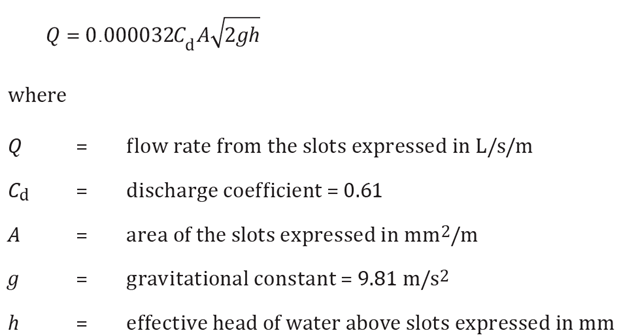
F.4.3 Slotted gutters Equation F.4.3 shall be used.
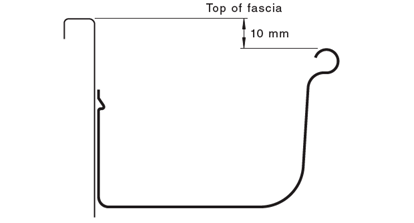
F.4.4 Front bead overflow If the front bead of the eaves gutter is positioned a minimum of 10 mm below the fascia, the overflow capacity Q shall be taken as 1.5 L/s/m, see Figure F.2. Figure F.2 - Construction of controlled front bead height
Source: ABCB Housing Provisions Figure 7.4.6c was provided by the Australian Building Codes Board © 2022 under the CC BY ND licence. F.4.5 Design by computational methods Note: Computational Fluid Dynamics (CFD) is a field of engineering and applied mathematics that deals with the numerical simulation of fluid flow and heat transfer. It uses mathematical models and numerical methods to analyse and solve problems related to the behaviour of fluids, such as liquids and gases, in motion. |