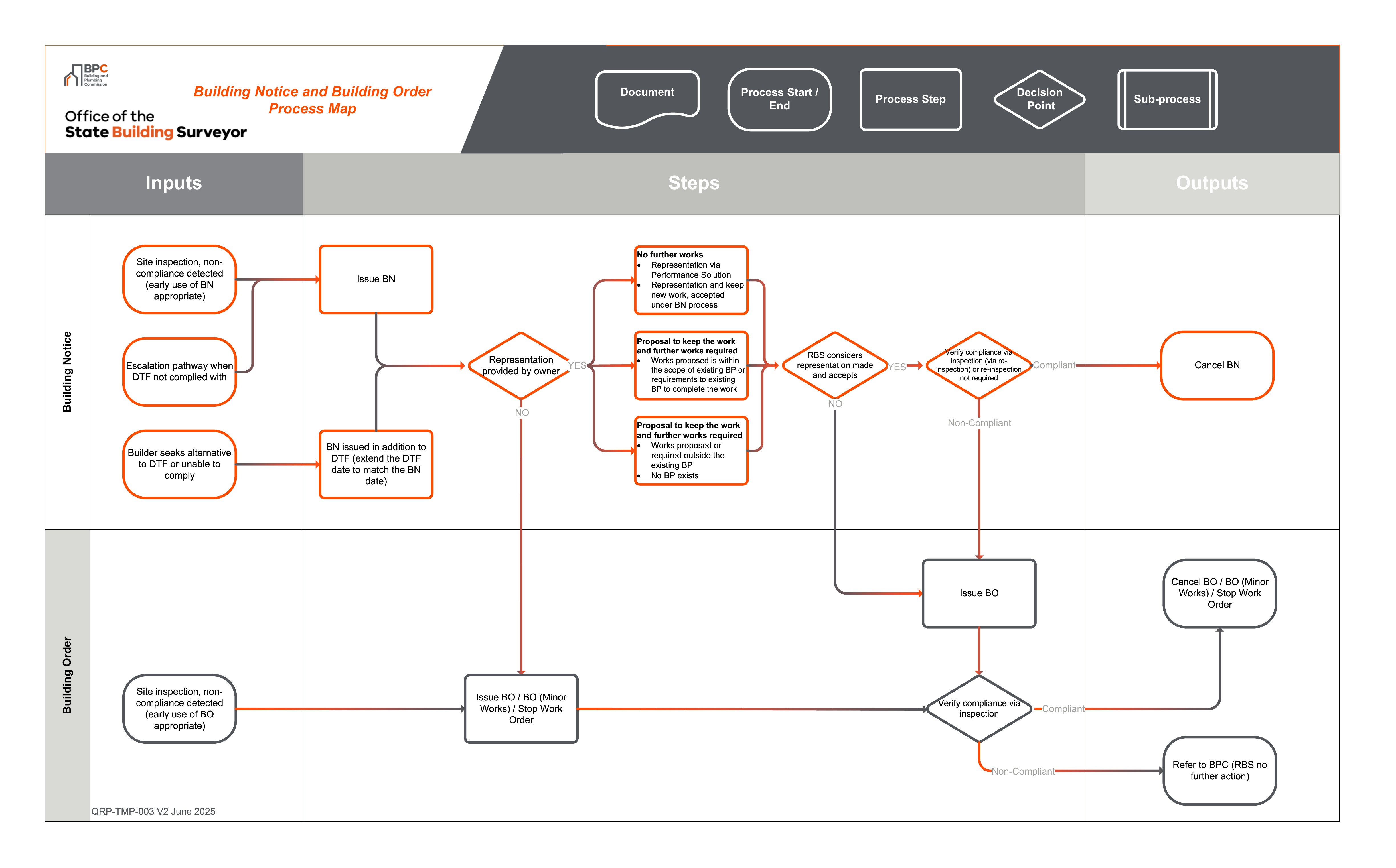
This Practice Note provides guidance on and outlines the roles and responsibilities of building surveyors (including private building surveyors (PBS) and municipal building surveyors (MBS)) with respect to the selection, issue, serving and compliance management of Building Notices (BN) and Building Orders (BO), including how to address non-compliance and appeals.
Building surveyors (PBS and MBS) play an essential frontline role in the enforcement of the Building Act 1993, (the Building Act), Building Regulations 2018 (the Regulations), and maintaining the system’s integrity.
Where a BN or BO under Part 8 of the Building Act may be appropriate refer to Practice Note NO-03 Enforcement tool selection guide there are context-specific considerations for tool selection and use.
These are outlined in Table 1, which:
summarises legislative requirements
describes common considerations for tool use
notes the Section of the Building Act and the applicable form set by the Regulations.
Table 1 is a general guide. In all cases, the building surveyor must understand and follow the Building Act’s requirements.
Under Section 107, a PBS may only serve a BN or make a BO if they have been appointed as the relevant building surveyor (RBS).
This power continues after the building work is complete.
Table 1: Building notice and building order overview
Enforcement tool
Issued to
Typical reasons to apply
General guidance
Building Notices
Section 106
Form 11
Owner
Builder unable to comply with direction to fix (DTF)
Building work carried out without a building permit or in contravention of the building permit
The use of the building contravenes the Building Act or Regulations
Essential safety measures (ESM) have not been maintained in accordance with the occupancy permit (OP)
Building or place is unfit for occupation
Danger to life, safety or health to member of the public or person using the building.
A BN must be served to the owner, not the occupier
A BN is not a direction, nor does it authorise the carrying out of building work, demolition or removal. It only to provides an opportunity for the owner to show cause
BN is a pre-requisite requirement prior to the issue of a BO (general)
BN and BO are tools to be used as a last resort as per Section 118A. First consider the appropriateness of a DTF, if a building permit applies
Ensure a property title search is carried out prior to BN preparation. If the property owner is a company, search for the Australian Company Number (ACN) to find the registered office details
If there is more than one owner, the notice should be sent to all owners, or alternatively, where a notice is to be served on an owner or owners of a lot affected by an owners corporation, the notice may be served on the owners corporation and if so is taken to be served on the owner, pursuant to Section
236(4C).
Building Orders – general
Section 111
Form 12
Owner or Occupier & a builder subject to Section 111 (8)
Failure to meet the timeframe specified in the BN for owner to make representation
Representations made and considered by RBS resulting in works needing to be undertaken (with or without an amended or new building permit (BP)).
Specify the time or times within which the order must be complied.
Building Orders to stop building work
Section 112
Form 13
Owner or other person
Contravention of the Building Act or Regulations
Danger to life, safety or health to member of the public or person using the building, land or place or to any property
Affects the support of any adjoining property.
The BO may be made without first serving a BN
Must stop building work except for reason under Section 112(5) and Section 112(6)
A BO to stop building work may be served on any person apparently in charge of the building site.
Building Orders – minor building work or action
Section 113
Form 14
Owner
Building work carried out without a building permit or in contravention of the BP
The use of the building contravenes the Building Act or Regulations
ESM have not been maintained in accordance with the OP
Building or place is unfit for occupation.
Danger to life, safety or health to member of the public or person using the building
Work of minor nature to reduce, remove (partially or wholly) building work, protection work and other work.
The BO may be made without first serving a BN
The same general guidance applies as for Section 106 BNs except that the RBS considers that the work required to be carried out, is ‘of a minor nature’.
Emergency Orders (EO)
Section 102
Form 10
Owner, occupier or builder
Building, land on which building work is being or is proposed to be carried out, place of entertainment is a danger to life or property due to its condition, or use or proposed use.
The MBS must give a copy of the EO to the PBS appointed to perform a function in relation to a building.
EOs to vacate (Section 103) must specify a period, not exceeding 48 hours for the duration of the BO.
If longer periods are needed, before the expiry of the EO, a BN can be issued to show cause why entry/occupation should not be prohibited. This can thereby extend the duration of the EO until the end of specified time in the BN or 14 days – whichever occurs earlier.
Notes
Section 118A states that BN/BO are to be a last resort, unless a DTF has not been complied with, or a DTF is not appropriate or possible to issue. Where a BP is in place and the non-compliance relates to this, refer to Practice Note NO-03 Enforcement tool selection guidance.
The MBS or PBS (subject to Section 107 of the Building Act) can issue all the above tools, except for EOs where only an MBS acting within their municipality can issue.
A PBS is a registered building surveyor. An RBS is a PBS who has been appointed under part 6 of the Building Act, whose responsibilities include Part 8 of the Building Act in relation to their appointment. An RBS can also be an MBS in relation to an application to, or permit, approval, inspection, direction, notice or order issued by the MBS.
Section 119 states that a person who is carrying out work in accordance with an EO or BO, is not required to obtain a building permit or comply with the building Regulations, unless the RBS determines it is required and ‘so directs’ – it is recommended that the RBS direct whether a BP is required within the order, however the RBS is open to providing this direction in any manner they see fit.
Under Section 120, once the work under an EO or BO has been completed, the owner must notify the RBS in writing without delay. The RBS must then inspect the work and report to the relevant council that the order has been fully complied with or require the order to be fully complied with.
The RBS must provide copies of notices and orders to the relevant council
Under Section 125, the RBS must:
give to the relevant council a copy of a BN, BO, or EO within 7 days of making the BN or making the BO or EO, and similarly
provide written notice to the council within 7 days after it has been fully complied with, amended or cancelled.
Building notices
As summarised in Table 1, Section 106 sets out the circumstances for the issue of BN.
The notice is an opportunity for the owner of a building or land on which building work is being, or is proposed to be carried out, or a Place of Public Entertainment (POPE), to make representations before further enforcement action is taken.
A building notice provides for owner representations and the pathway to the order
Once a BN is served, the owner may make representations to the RBS within the time and manner specified in the BN.
When the RBS receives and considers representations from the owner within the specified time, they may cancel the BN if appropriate to do so.
If the RBS is not satisfied that the representations are sufficient to cancel the BN, they must proceed with making a BO.
Notes
A BN is not a direction, nor does it authorise the carrying out of building work, demolition or removal. The BN only provides an opportunity for the owner to show cause why certain action outlined in the BN should not be taken.
In the circumstances where the owner makes representation that requires further work, the BN may then proceed to issue of BO to carry out those works.
Note: A BN is required to be issued prior to the issue of BO general.
A building notice may follow direction to fix non-compliance
When serving the BN because a DTF cannot or has not been complied with, a copy of the relevant DTF should be attached to the BN.
Building notices and danger to life, safety or health
Under Section 108(1B), if a BN is issued due to there being a danger to life, safety or health, it can also require the owner to show cause why the owner should not take action that is necessary to remove, reduce or address the danger.
In such circumstances where there is a danger, the action does not necessarily need to fit within the definition of ‘building work’ under the Building Act and therefore can be any appropriate action.
Building orders
A BO is an order to carry out or refrain from carrying out a certain action, made under Sections 111 - 113.
A BO general made under Section 111 can only be made after considering any representations made by the owner and at the end of the specified time to make representations in the BN.
The BN and BO must be consistent in subject matter, as any additional matters that were not specified in the BN, or otherwise reflect the representations made, cannot be accounted for through the BO process.
When dealing with additional matters not in the BN or representations, the RBS may need to issue a new BN instead of amending the existing BN, as otherwise the validity of the BO can be challenged.
Building order to stop work
Where a BO to stop building work is made, the:
RBS may exempt any part of the building work from a BO for reasons under Section 112(6), such as in the interests of safety, or to avoid a public nuisance
person to whom it is directed must stop the building work, except for reasons under Section 112(5), such as work to comply with a BO general, a DTF, or works exempted under Section 112(6).
Emergency orders
An emergency order (EO) is an order to do or refrain from doing certain actions set out under Sections 103 and 104.
An EO can only be issued by the MBS if the MBS is of the opinion that there is a danger to life or property.
Section 228J allows an authorised person (MBS) to enter a building or land without a search warrant. This power can be used by an authorised person where the safety of the public or occupants of the building or land is at risk, or an EO applies under Part 8 to the building or land.
Private building surveyors notifications relating to danger to life or property
A PBS must notify the MBS of a situation where there is a danger to life or property so that the MBS can consider making an EO. As part of the code of conduct for building surveyors (2.5.1), a PBS must always take action to refer a matter of danger to life or property to the MBS to consider the issue of an EO. All building practitioners are strongly encouraged to refer any matter to the MBS for consideration of the issuance of an EO, where the matter presents a danger to life or property.
For the PBS (as RBS), where there is a danger to life or property, they should:
Identify the risk : if the non-compliance could endanger life or property, do not delay
Refer to the MBS : provide details of the issue so the MBS can decide if an EO is required
Continue enforcement: the RBS may need to take other actions alongside MBS responses, such as issuing a DTF for broader building work for matters not relating to the EO or issue a BN to support the EO.
Examples of situations where the PBS may need to notify the MBS can include the following where there is a danger to life or property:
swimming pools with inadequate pool barriers
inadequate or deficient balconies and balustrades
fire safety issues, such as deficient egress provisions or missing smoke alarms
inadequately secured building elements, for example unprotected site cuts, unpropped or braced walls exposed during construction.
Emergency order provisions and timeframes
Key provisions of EOs:
they must include information set out in Regulation 177 of the Regulations
the MBS must give a copy of the EO to any PBS appointed to perform a function in relation to the building, land or place, per Section 105(3)
subject to Section 105A, an EO remains in force until it is complied with or cancelled by the MBS under Section 105B or the Building Appeals Board under Section 142.
Timeframes for an EO:
when an EO is issued under Section 103 requiring a building or land or POPE to be evacuated or prohibiting entry, it must specify a period not exceeding 48 hours for the duration of the order. If before the end of the period specified in the EO, the MBS issues a BN asking an owner to show cause why entry into, or the use or occupation of, the building or place that is subject to the order should not be prohibited, the EO remains in force until the earlier of:
14 days or
the end of the period specified under Section 108 for the BN.
where an EO is issued under Section 104, the EO remains in force until it is complied with or until it is cancelled by the MBS under Section 105B, or by the BAB under Section 142.
Serving of building notice, building order and emergency order
A BN, BO, EO may be served via the methods referenced under Section 236. These are summarised in Table 2, with additional guidance.
Table 2: Methods of service
Methods
Guidance
Delivering the document to the person.
Keep a file note of the date, time, and who the recipient was.
Leaving the document at the person's usual or last known place of residence or business with a person apparently not less than 16 years of age and apparently residing or employed at that place.
Keep a file note of the date and time the document was served
Do not serve documentation to a person below 16 years of age. ID check is not required, and keep a file note of the person’s name, date and time.
Sending the document by post addressed to the person at the person's usual or last known place of residence or business or in any other prescribed manner.
Via normal post allow for 7 business days, not including weekends and public holidays
Not recommended to serve document via registered post or to serve document to a PO Box.
Putting in a conspicuous position on the land (where owner name and address unknown and there is no occupier).
For example, affixed to the entry door of a building on the land, or if vacant land affixed to a boundary fence
Consider appropriate method of affixing the notice to prevent effects of weather and causing damage
Take photographic evidence with date/time stamp.
For an EO to evacuate/prohibit entry under Section 103, a BN under Section 108(1), or BO under Section 111(3) or (4), the document may be served by putting up the order or notice in a conspicuous position on the building, land, or POPE.
For example, affixed to the entry door of a building on the land, or if vacant land affixed to a boundary fence
Consider appropriate method of affixing the notice - to prevent effects of weather and causing damage
Take photographic evidence with date/time stamp.
Notes
For email service of BN and BO: The Building Act does not expressly provide for email service. Whilst the Electronic Transactions Act 2000 can provide for email service in some situations, it is not recommended for BNs and BOs, as these are generally given to home owners and systems may not be in place to provide for valid email service (for example, preexisting confirmation for electronic service of legal documents, verified email addresses and other). However, in addition to the above serving methods, an email can be a courtesy version of the service.
For owners corporations: If a BN or BO is to be served on an owner of a lot affected by an owners corporation, the notice or order may be served on the owners corporation in lieu of serving the document on each individual lot owner. An owners corporation served with a BN or BO must provide a copy to each affected lot owner within a reasonable time.
Enforceability of the building notice or building order
To ensure the enforceability of the instrument, make sure the BN or BO is issued to the correct person – usually the owner of the building/land/place, and clearly:
establish the reason why the notice/order was made
describe the expected actions to bring about compliance
refer to the relevant standards and their year or publication.
Timeframes for compliance should be reasonable, accounting for the nature of the non-compliance and risk and the likely steps required.
In most cases, a BO is issued following the expiration of the show cause period issued under a BN. The exception is where a BO (Minor Work) or BO (Stop Work) can be issued without a BN having first being issued. Where a BO is issued following a BN, the BO must contain key dates from the BN and related inspections.
It must:
not be issued before the owner representations period finishes
not go beyond the scope of the notice (accounting for owner representations).
Any inconsistency between the BN and BO may make the notice or order unenforceable.
Appeals
Section 142 allows the owner to appeal to the Building Appeals Board (BAB) against a BN, BO, or EO for a variety of reasons, such as the decision to serve a BN, the making of a BO, a condition of a BO or the refusal to cancel a BN, BO or EO.
The prescribed appeal periods (30 days) are under Regulation 271(1)(o)-(s) of the Regulations.
Amendment or cancellation of building orders
The amendment or cancellation of BOs can be requested by the owner if there is a change in circumstances.
On a request being made, the RBS may amend or cancel the BO or refuse the request.
A BO remains in force until complied with or cancelled by the RBS or the Building Appeals Board. Under Section 236(6), BOs validly served on the owner or occupier are binding on every subsequent owner or occupier of the land.
Non-compliance with building orders
If a person fails to comply with a BO made by a PBS, then under Section 115, the PBS must refer the matter to the BPC within fourteen days after the final date for compliance specified in the order.
When referring a BO to the BPC, the PBS must ensure the time when the BO is referred is not premature, i.e. prior to the expiry date.
Once referred, the PBS must take no further action in regarding the subject matter of the BO. Enforcement of the BO becomes the responsibility of the BPC.
The PBS may however still have other obligations with respect to the site and non-compliances not the subject of the order and is encouraged to share information or updates with the BPC if they become aware of actions taken by the recipient.
On referral, the BPC may communicate with the person responsible for compliance with the order, to let them know the matter has been escalated, and the potential consequences for failing to comply. The BPC will then assess the case to determine the appropriate response. Where there are deficiencies in the BN or BO, the BPC may engage with the PBS to resolve them.
Record keeping
Documenting and maintaining records related to these instruments is of paramount importance for RBS. This is essential for demonstrating compliance with legal and evidentiary obligations, especially in cases of referrals or disciplinary actions, and is explicitly required by the Code of Conduct for Building Surveyors in Victoria:
building surveyors must record all relevant information gathered during their services
decisions must be supported with documented reasons
all advice, opinions, decisions, and actions must be backed by evidence and factual findings
documentation must be sufficient to meet BPC audit or investigation requests
records may need to be provided to third parties in future regulatory or legal processes.
Figure 1: BN and BO process map (excludes emergency orders)